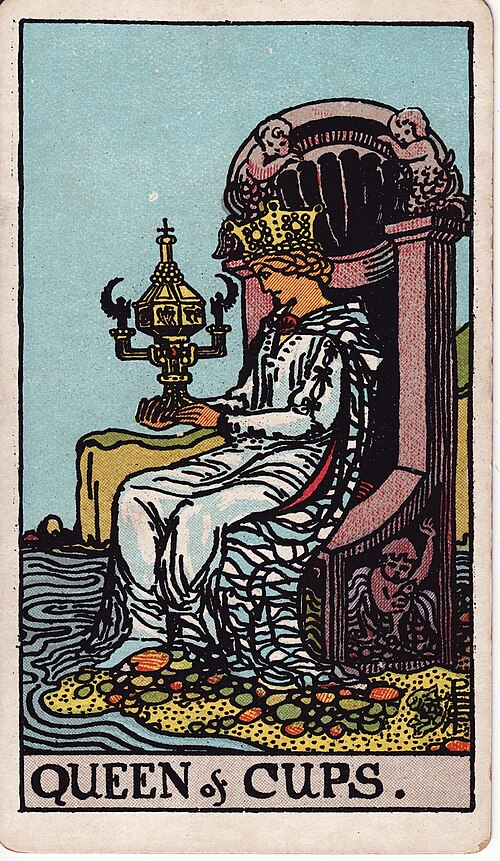
Queen of Cups Tarot Card Meaning
The Queen of Cups is a Minor Arcana court card, the Queen rank of the Cups suit, and position 49 in this 78-card RWS sequence. She follows the Knight of Cups and comes before the King of Cups. Cups are traditionally used to organize emotion, relationship, imagination, receptivity, and inner experience; the Queen gives those themes a listening, containing, and discerning form. This is a symbolic-reading framework for reflection, not a scientifically validated prediction or a fixed description of a person.
RWS visual details: a gaze turned toward feeling
In the RWS image, a crowned woman sits on an ornate stone throne beside a body of water. Her body is shown in profile or three-quarter view, and her attention turns downward toward the elaborate cup she holds. The cup is unusually detailed and appears closed or covered, with winged or angel-like ornament around it. The Queen is not shown pouring it out or offering it to another figure; she is looking at it closely. Blue and pale tones in the water and clothing create a cool atmosphere, while red and gold accents in the robe, crown, and throne add warmth.
The foreground is a pebbled shore, and the water extends behind the throne toward a low horizon. The throne's decoration echoes sea or wing imagery, making the object she studies feel like a vessel with its own symbolic life. The image has no crowd or obvious external task. Its directions matter: the Queen's attention moves inward and downward, while the water gives the scene a broad, shifting background. These are observable image cues; interpretations such as compassion, intuition, or emotional maturity are traditional and editorial developments from those cues.
Arthur Edward Waite's public-domain Pictorial Key to the Tarot is credited to Waite with illustrations by Pamela Colman Smith and is dated 1911 in the archive edition. Waite's brief court-card meanings are one historical layer. This article combines that RWS lineage with close image observation and modern, practical self-reflection without treating later associations as certain historical facts.
Keywords explained from image and tradition
- Receptivity — her lowered gaze and still posture show attention before action.
- Emotional literacy — the cup becomes an object to examine, suggesting that feelings can be noticed and named.
- Compassion — the receptive Queen can make room for experience without immediately judging it.
- Imagination — ornate cup and water connect feeling with symbol, memory, and creative inner life.
- Containment — a covered vessel suggests privacy, boundaries, and care with what is held.
- Discernment — she studies one cup rather than reacting to the whole landscape.
- Shadow keywords: absorption, moodiness, indirectness, or emotional overprotection when receptivity loses boundaries.
Upright Queen of Cups meanings
Upright, the Queen of Cups points to feeling that is deep, attentive, and capable of response. The core dynamic is not simply being sensitive; it is receiving information from emotion and deciding how to care for it. Her strength is a patient presence that can listen, imagine another perspective, and respond without making every feeling public. In a relationship, this may support tenderness and honest emotional conversation. In a project, it may mean noticing the human context that a purely technical plan missed.
Her strengths include empathy, careful listening, creative perception, emotional steadiness, and respect for privacy. The risk of excess is porousness: taking responsibility for everyone else's mood, confusing intuition with certainty, avoiding a needed boundary, or staying in a private emotional world so long that practical information is ignored. A useful upright action is to pause, identify the feeling, check it against observable facts, and then choose a caring response with a clear limit.
- Core dynamic: receive, interpret, and respond with care.
- Potential strength: offer calm attention, creative insight, or compassionate mediation.
- Risk of excess: absorb another person's distress, idealize a situation, or withhold a necessary truth.
- Practical action: name the emotion, verify the evidence, state a boundary, and make one small supportive choice.
Reversed Queen of Cups meanings
Reversed does not automatically mean that compassion is bad or that an emotional outcome is doomed. It changes the direction, availability, or proportion of the Queen's qualities. The cup may be turned inward, protected, overflowing, or difficult to read. Interpret the reversal with the question and surrounding cards rather than using it as a simple negative switch.
- Blockage: feelings are hard to identify, trust, or communicate, so listening becomes silence or avoidance.
- Internalization: the person processes everything privately and may need solitude, but can become isolated if no safe conversation follows.
- Excess: empathy becomes rescuing, emotional fusion, rumination, mood-led judgment, or an assumption that intuition proves another person's motives.
- Delay: a decision waits while someone seeks perfect emotional certainty or keeps revisiting an old hurt.
- Direction adjustment: move from absorbing to observing
- separate what you feel, what you know, and what you can responsibly do.
- Constructive reversal: a private retreat, creative practice, or firm boundary may restore emotional capacity rather than signal failure.
Applications in ordinary life
- Relationships and emotions: Upright, she favors attentive listening, tenderness, and a relationship that can hold vulnerability. Reversed, ask whether care has become caretaking, unspoken resentment, or emotional withdrawal. The card cannot reveal what a third party secretly thinks
- use it to clarify your own observations, needs, and boundaries.
- Work and study: Upright, use emotional intelligence in collaboration, counseling, design, writing, or any work requiring careful observation. Reversed, check distraction, blurred roles, or reluctance to ask for clear feedback. Put the insight into a schedule or a written question.
- Money and resources: Upright, make humane choices while still checking figures, contracts, and limits. Generosity should be deliberate, not a way to purchase security. Reversed, watch emotional spending, lending from guilt, or avoiding a budget because numbers feel stressful
- seek qualified financial advice for consequential decisions.
- Personal growth: Practice naming feelings without making them commands. A journal, art, contemplative pause, or trusted conversation can help, but emotional reflection should be paired with evidence and a concrete next step.
Queen of Cups in spreads and positions
A card does not have one answer outside its position. The Queen may describe a person, an attitude, a resource, a missing capacity, or the way the question is being approached. Read her vessel, gaze, water, and boundaries in relation to the prompt and neighboring cards.
- One-card prompt: What feeling deserves careful attention today, and what boundary would help me hold it well? The emphasis is on observation plus an actionable limit, not on predicting an event.
- Three-card past, present, future: In the past, she may show an emotional lesson or caring influence
- in the present, a need to listen and regulate
- in the future, a possible capacity for compassionate response. Treat the future as a direction to practice, not a guarantee.
- Three-card situation, action, outcome: She can describe the emotional atmosphere, advise a measured and empathic action, and show an outcome shaped by emotional honesty. A difficult surrounding card may make boundaries more important than soothing.
- Relationship — self, other person, interaction: In self, examine your emotional posture and needs. In the other-person position, read a style of relating or the role they play in the situation, not their private thoughts. In interaction, ask whether feeling is being shared, protected, or absorbed.
- Decision — opportunity, risk, advice: The opportunity may be a humane or creative response
- the risk may be idealization or over-giving
- the advice is to consult feeling alongside facts and set terms before committing.
- Obstacle, advice, outcome: As obstacle, unspoken emotion or porous boundaries may cloud the issue. As advice, listen, clarify, and protect your energy. As outcome, she suggests a more emotionally literate response, not an automatically happy result.
Instructional combination reading
Instructional example, not a real case: place the Knight of Cups beside the Queen of Cups. The Knight's moving offer or ideal can become the Queen's careful emotional evaluation; together they suggest receiving an invitation while checking whether it is sustainable. If the King of Cups follows, feeling may mature into steadier regulation. These adjacent cards modify one another; none is a fixed answer by itself.
Common misreadings, traditions, and responsible use
A common misreading is reducing the Queen to a romantic woman, a mother, or a psychic who always knows the truth. Court cards can describe a role, behavior, stage of development, or interaction, and they do not assign personality by gender, age, or sexual orientation. Another mistake is treating the closed cup as proof of secrecy; it can just as reasonably support privacy, concentration, or reverence. Some schools use elemental, astrological, or personality correspondences differently, and some do not use reversals. Marseille and other pip-based traditions also differ in imagery and court-card conventions. RWS places Strength at VIII and Justice at XI, while Marseille commonly reverses those numbers and uses different imagery; this series uses RWS order and primary image analysis.
Use tarot as a cultural and symbolic language for self-reflection, conversation, and creative practice. Do not use the Queen of Cups to diagnose mental or physical illness, read a third party's mind, decide a legal or investment matter, or promise a guaranteed outcome. For health, safety, legal, financial, or relationship decisions with serious consequences, use relevant professional support and direct evidence. A card can help frame a question; it cannot replace consent, communication, or informed choice.
Tarot journal prompts
- What emotion am I observing, and what facts support or complicate my first interpretation?
- Where am I offering care freely, and where am I taking responsibility that belongs to someone else?
- What would a clear, kind boundary look like in the situation represented by this card?
Suggested learning links
- Previous card: Knight of Cups — tarot-card-knight-of-cups.
- Next card: King of Cups — tarot-card-king-of-cups.
- Foundational reading: Tarot for Beginners — tarot-for-beginners
- Cups Suit Guide — tarot-cups
- Upright and Reversed Tarot — tarot-upright-and-reversed
- Three-Card Tarot Spreads — three-card-tarot-spreads
- Tarot Journal Review — tarot-journal-review.