Page of Wands at a glance
In the Rider-Waite-Smith (RWS) tradition, the Page of Wands is a court card in the Minor Arcana and the thirty-third card in the 78-card sequence. It follows the Ten of Wands and comes before the Knight of Wands. Its central movement is the first meeting with an idea, invitation, message, or creative impulse: something has arrived, but it still needs testing, skill, and direction. This is symbolic reading for reflection, not a scientifically validated method of predicting events.
RWS and Marseille traditions differ in some imagery and in the numbering of Strength and Justice. RWS places Strength at VIII and Justice at XI; many Marseille decks reverse those numbers. This series follows RWS order and uses the RWS image for primary analysis.
What the RWS image shows
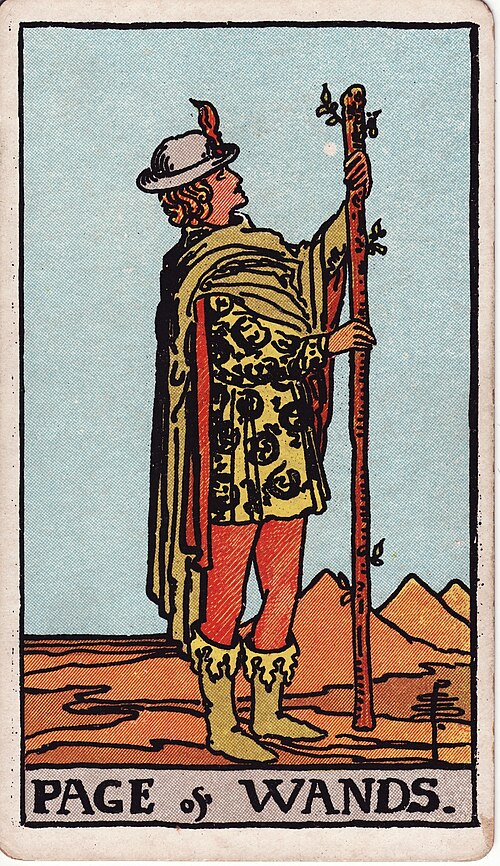
A young figure stands on warm, dry ground in profile, looking toward an upright wand held before the body. The figure wears a yellow tunic marked with salamander-like forms, red leggings, and a cap with a red feather. The palette is dominated by yellow, orange, red, and brown. Low hills and an open sky leave the figure exposed rather than enclosed by a settled town or room. Fresh leaves appear on the wand, giving the otherwise arid scene a visible sign of growth.
These details support a reading of attention, discovery, and potential. The figure is not shown completing a grand task; the figure is examining a living tool. The wand's new leaves suggest that the impulse is real but early. The open landscape allows movement, while the dry ground reminds us that enthusiasm alone is not the same as preparation. Direction in the picture is a visual cue, not a fixed prediction: attention is being placed on what might be developed next.
Keywords derived from image and tradition
Useful keywords are curiosity, message, apprenticeship, initiative, enthusiasm, experiment, and restlessness. Curiosity follows from the figure studying the wand. Message and invitation arise from the Page's traditional role as a bearer of news or a beginning stage of expression. Apprenticeship follows from youth and the still-growing wand. Initiative and enthusiasm describe the active fire of Wands, while experiment and restlessness keep the meaning honest: this card begins a process and does not promise mastery.
- Curiosity: look closely before deciding what the new signal means. Message: clarify what is being offered or communicated. Apprenticeship: learn by practice rather than performance. Initiative: make a small first move. Experiment: test the idea in reality. Restlessness: watch for excitement that changes direction before it produces results.
Upright Page of Wands meaning
Upright, the Page of Wands describes a lively beginning. A new idea may deserve a trial, a conversation may open a door, or a person may feel ready to study a subject with genuine interest. Its strength is responsiveness: it notices possibility, asks questions, and is willing to learn in public. The Page can bring honest excitement, playful creativity, a clear invitation, or the courage to say, “I want to find out.”
The risk is excess. Curiosity can become distraction, confidence can become performance, and a promising message can be sent before its details are checked. The practical response is to give the spark a container: name the goal, verify the information, choose one experiment, and set a review date. Upright does not guarantee a positive outcome. It suggests a useful starting posture, while results still depend on context, effort, consent, and feedback.
Reversed Page of Wands meaning
Reversed, the Page of Wands can show blockage around a new beginning, internalization of an idea that has not yet been expressed, excess enthusiasm without a workable plan, delay in sending or receiving a message, or a need for direction adjustment. It may describe a learner who fears looking inexperienced, a creative project that keeps restarting, or news that is incomplete. Reversed does not automatically mean failure or bad character; it can simply show that the spark needs privacy, practice, or better timing.
Check what is actually stuck. If the blockage is fear, lower the stakes and make a private draft. If the issue is excess, remove extra commitments and protect attention. If there is delay, confirm the facts and agree on a realistic next step instead of forcing urgency. If the direction is wrong, revise the question before pushing the action. The reversed card asks for honest calibration: what would make this beginning safer, clearer, and more teachable?
Applications in ordinary life
Relationships and emotions: The Page can emphasize a fresh conversation, playful interest, a shared activity, or the courage to name a feeling without turning it into a demand. For an established relationship, it may recommend curiosity about the other person's experience rather than assuming you already understand it. It does not reveal a third party's private thoughts. Reversed, it can point to mixed signals, awkward disclosure, emotional immaturity, or a feeling being kept inside until it can be expressed responsibly.
Work and study: Upright, begin the course, pitch the small pilot, ask the beginner's question, or investigate a role that genuinely interests you. The Page favors learning through direct contact and visible practice. Reversed, check whether procrastination is really fear of evaluation, or whether the project lacks scope and instruction. A short study block, a mentor question, and a concrete draft are more useful than repeatedly waiting to feel fully ready.
Money and resources: This card can describe a small opportunity, a new income experiment, or an early-stage skill that may later become useful. Treat it as a proposal to investigate, not as a guaranteed return. Compare costs, terms, time, and downside before committing. Reversed, pause for missing details, impulsive spending, or a plan built on excitement rather than cash flow. Use ordinary budgeting and qualified advice for financial decisions.
Personal growth: The Page invites a beginner's mind and a tolerable amount of uncertainty. Choose a practice that lets you observe progress rather than prove an identity. Reversed, notice whether self-criticism is blocking exploration or whether constant novelty is preventing depth. Growth may mean completing one modest exercise before seeking another inspiring beginning.
Page of Wands in spreads and positions
One-card prompt: ask, “What new signal deserves a grounded experiment today?” The card may emphasize a question, message, or first action rather than an event. In a three-card past, present, future spread, the Page in the past can show an earlier invitation or unfinished curiosity; in the present it highlights a live learning moment; in the future it suggests a possible opening that still requires preparation. In a situation, action, outcome spread, it frames the situation as a spark, recommends a testable first move, and treats the outcome as information rather than a guarantee.
In relationship positions, Page of Wands as self describes your willingness to explore and communicate; as the other person it describes the role or behavior visible in the situation, not a claim about their private mind; as interaction it suggests a connection animated by discovery, flirting, shared learning, or inconsistent signals. In decision positions, it can show an opportunity worth researching, a risk of acting on novelty alone, and advice to begin small while staying responsive to evidence.
In obstacle, advice, and outcome positions, the Page changes emphasis again. As obstacle, scattered attention or fear of being new may prevent progress. As advice, ask one clean question, make one reversible experiment, and learn from the response. As outcome, expect a clearer signal, first result, or new lesson rather than a completed mastery. The position limits the meaning; no card has one fixed answer outside its question.
Instructional combination reading
Instructional example, not a real case: Ten of Wands, Page of Wands, Knight of Wands can be read as a sequence in which accumulated burden creates the need for a new, lighter idea, and that idea then seeks decisive movement. The Ten modifies the Page by warning against adding another task without releasing an old one. The Knight modifies the Page by increasing speed and risk. Together they do not promise success; they invite a staged plan from burden, to experiment, to accountable action.
Common misreadings, traditions, and responsible use
Do not reduce the Page to a literal child, a guaranteed message, or an automatic sign of pregnancy, travel, or success. Court cards can describe a person, role, communication style, learning phase, or temporary behavior, and they need not map to gender or age. Some decks portray the Page as a more formal attendant; Marseille pip traditions may require different visual methods, and not every reader uses reversals. Keep the chosen school consistent, state when a meaning is traditional rather than observable, and test interpretations against the question and real-world evidence.
Tarot can support cultural study, symbolic reading, and self-reflection. It should not replace medical, legal, financial, or mental-health advice, and it should not be used to claim certainty about another person's mind or a guaranteed fate. For consequential choices, use documents, consent, qualified professionals, and practical risk checks. A responsible reading leaves room for agency and revision.
Tarot journal prompts
- What new interest am I observing, and what visible evidence would make it worth pursuing? Which small experiment can I complete without overcommitting? Where is fear of inexperience causing blockage or delay? What feedback would tell me to adjust direction rather than abandon curiosity?
Suggested learning links and source note
Continue to the previous card, Ten of Wands (tarot-card-ten-of-wands), and the next card, Knight of Wands (tarot-card-knight-of-wands). For foundations, pair this article with Tarot for Beginners (tarot-for-beginners), the Wands suit guide (tarot-wands), Upright and Reversed Tarot (tarot-upright-and-reversed), Three-Card Tarot Spreads (three-card-tarot-spreads), and Ethics and Boundaries (ethics-and-boundaries). The historical reference point is A. E. Waite's The Pictorial Key to the Tarot, published in 1911 with illustrations by Pamela Colman Smith; visible image description, later practice, and this article's practical synthesis are kept distinct.