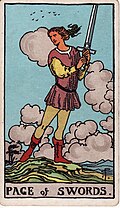
Page of Swords at a glance
The Page of Swords is a Minor Arcana court card, the eleventh card of the Swords suit and position 61 in this site's 78-card Rider-Waite-Smith (RWS) sequence. It is best read as a mode of attention, communication, learning, or early-stage action rather than as a literal child or a guaranteed message. The card asks how carefully we observe, what we are willing to question, and whether our words are serving clarity or merely creating movement.
This series follows the RWS order and imagery. RWS places Strength at VIII and Justice at XI, while many Marseille traditions reverse those numbers and use different visual conventions, especially in the Minor Arcana. Those differences matter; the interpretations here use the illustrated RWS deck associated with Pamela Colman Smith and A. E. Waite, published by William Rider & Son in 1909. Historical associations and modern reflective practices are kept distinct, and tarot is treated as a symbolic and cultural tool, not a scientifically validated method of prediction.
Visible RWS imagery
A youthful figure stands on uneven, yellow-green ground beneath a pale blue sky. The body is angled toward the left while the head and attention turn with the upright sword, giving the scene a watchful, unsettled quality. The blade rises into the air; it is not sheathed or resting. The figure's patterned tunic, red accents, cap plume, and braced stance make the person look prepared, but not yet settled into a mature role. Wind moves the clouds and distant trees. The open background provides no enclosing wall or institution, so the figure's information and authority remain exposed to changing conditions. These visible details support alertness, curiosity, vigilance, and the need to test an idea before acting on it.
Keywords and how the image produces them
The concise keyword set is alertness, inquiry, communication, learning, vigilance, and mental agility. The raised sword gives inquiry a sharp edge: attention is directed upward and outward, toward a fact, question, or distinction. The standing figure suggests readiness, while the uneven ground and moving air qualify confidence with instability. Traditional court-card practice also treats a Page as a beginning, student, messenger, or developing expression of a suit. For Swords, that developing expression concerns thought, language, judgment, boundaries, and conflict. The keywords therefore describe observable posture plus a tradition of reading rank and suit; they are not fixed predictions.
- Alertness follows the upright sword and scanning posture
- inquiry follows the figure's active attention
- communication follows the suit's association with language and judgment
- learning follows the Page rank
- vigilance follows the exposed, windy setting
- mental agility follows the readiness to turn information into a considered response.
Upright Page of Swords meaning
Upright, the Page of Swords highlights a mind that is awake and willing to investigate. Its strength is honest curiosity: ask a precise question, gather the relevant facts, listen for the exact wording, and notice what has not been said. It can describe study, a new line of research, a candid conversation, an alert colleague, or the first draft of an argument. The card favors direct observation over assumption and a flexible plan over a performance of certainty.
The risk of excess is mental agitation. An upright Page can become a person who comments before understanding, treats every uncertainty as a threat, or mistakes cleverness for wisdom. Suspicion, gossip, needless debate, and constant checking can exhaust both the reader and everyone around them. Practical action is therefore modest and verifiable: write down the question, separate evidence from interpretation, confirm a message with its sender, learn the missing skill, and choose one useful conversation instead of broadcasting every thought.
Reversed Page of Swords meaning
Reversed, the card does not automatically mean bad news or dishonesty. It can show a blockage in speaking or studying, information that is difficult to access, or a person who is not ready to express what they notice. Internalization may turn curiosity into private worry, rehearsed arguments, or fear of being judged. Excess may appear as rumor, surveillance, sarcasm, argumentative posting, or a quick conclusion built on incomplete evidence. Delay can affect a reply, an application, a decision, or the start of a course.
The direction adjustment is to slow the blade without abandoning discernment. Check the source, ask permission before investigating someone else's private matter, and distinguish a hunch from a fact. If communication is blocked, use a shorter message or a calmer channel; if study is delayed, reduce the task to one source and one question. If the card is internal rather than external, name the fear in a journal and ask what evidence would change the conclusion. A reversed Page can also indicate beneficial restraint: silence, editing, or waiting until a statement is accurate.
Applications in ordinary life
In relationships and emotions, the card can describe curiosity, a frank question, a new conversation, or the need to clarify mixed signals without pretending to know another person's mind. Upright, use direct but non-accusatory language. Reversed, watch for defensive texting, indirect tests, jealousy based on inference, or silence caused by anxiety. In work and study, it supports research, training, note-taking, fact-checking, and asking for precise feedback. Its warning is scattered attention or a sharp tone that damages collaboration.
For money and resources, the Page favors reading terms, comparing information, learning a skill, and delaying a commitment until the details are understood. It is not a promise of profit and should not replace financial advice or due diligence. For personal growth, it invites intellectual humility: keep the lively question, but practice listening, source evaluation, and responsible speech. A useful measure is whether your next action increases clarity without violating privacy or escalating conflict.
Page of Swords in spreads and positions
A card's position changes its emphasis. In a one-card prompt, ask: “What deserves careful attention before I speak or act?” The Page may point to a question, a source to verify, a conversation to prepare for, or a beginner's step. In a three-card situation, action, outcome spread, the situation is the information field and its assumptions; action is the specific question, message, or study habit that improves clarity; outcome is not fate but the likely quality of understanding produced by that practice.
- Relationship — self: examine how you are observing, speaking, or withholding
- other person: read the role or communication style shown by the card, not a private mind
- interaction: notice whether curiosity becomes mutual dialogue or suspicion. Decision — opportunity: research, learn, clarify, or open a candid exchange
- risk: haste, gossip, or incomplete evidence
- advice: verify before committing. Obstacle: mental noise, defensiveness, or a delayed message. Advice: ask one clean question and listen. Outcome: clearer terms or a better-informed next step, not a guaranteed event.
Instructional combination reading
Instructional example, not a real case: Page of Swords followed by Knight of Swords. The Page shows the question, fact-finding, or first message; the adjacent Knight accelerates it into action, debate, or a direct decision. Together they can describe research that quickly becomes a proposal, but they can also warn that an unverified observation is about to become a forceful claim. If the Page is reversed, the Knight's speed may magnify rumor; if the Knight is reversed, the Page's questions may need firmer boundaries and a slower reply.
Read the Page as a prompt to improve the quality of attention, not as proof that someone is watching, lying, or about to deliver inevitable news.
Common misreadings, deck differences, and responsible use
The Page is not automatically a child, a spy, an immature person, or a literal messenger. Court cards can describe a role, stage, method, or part of the querent's behavior, and they should not be assigned by gender or age. A Marseille deck generally gives numbered Swords pip cards rather than the RWS scene, while modern decks may change clothing, direction, symbols, or the Page's social context. Reversal methods also differ: some readers use them, some do not, and meanings vary by school.
Use the card for cultural learning, structured self-reflection, and questions that leave room for agency. Do not use it to read a third party's thoughts, diagnose health, make legal decisions, direct investments, or promise an outcome. For consequential choices, consult qualified professionals and check ordinary evidence. A reflective reading can support a conversation or a plan; it cannot replace consent, privacy, safety planning, or fact-checking.
Tarot journal prompts
- What fact, wording, or assumption do I need to examine before taking a position?
- Where am I turning curiosity into suspicion, and what respectful question would separate the two?
- What small study or communication action would make my next decision more informed?
Suggested learning links
Continue in sequence with Ten of Swords (tarot-card-ten-of-swords) as the previous card and Knight of Swords (tarot-card-knight-of-swords) as the next card. For foundations, pair this article with the Swords suit guide (tarot-swords), Tarot for Beginners (tarot-for-beginners), Upright and Reversed Tarot (tarot-upright-and-reversed), How to Ask Tarot Questions (tarot-how-to-ask), the Three-Card Tarot Spreads guide (three-card-tarot-spreads), and Tarot Journal Review (tarot-journal-review).