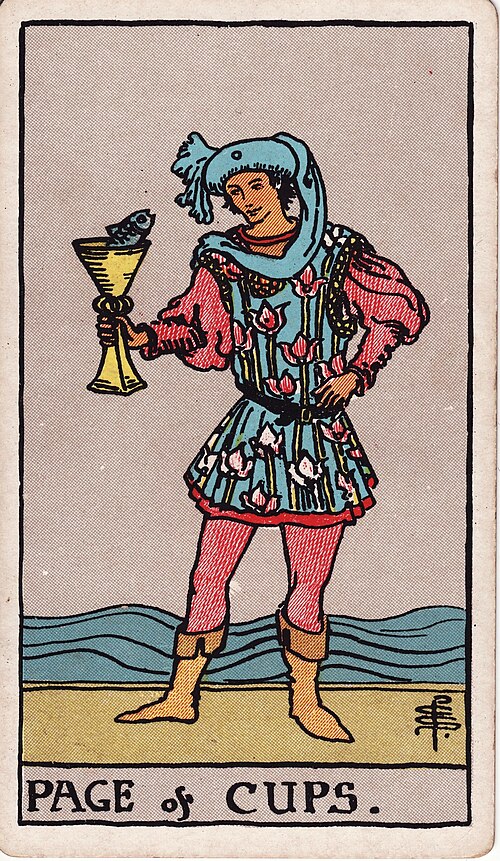
Page of Cups: identity and place in the RWS sequence
The Rider-Waite-Smith (RWS) Page of Cups is the eleventh card of the Cups suit, after the Ten of Cups and before the Knight of Cups. It is Minor Arcana card position 47 in this site's 78-card order. The Page is a court card rather than a fixed portrait of a child or a particular gender. It can describe a beginner, a messenger, a learning stage, or a way of approaching emotion: curious, receptive, and still discovering what a feeling means.
This article treats tarot as a symbolic-reading and self-reflection practice. Its meanings are an editorial synthesis of the visible RWS scene, traditional tarot commentary associated with A. E. Waite, and practical reading methods. They are not scientifically validated predictions. A card can help a reader frame a question and choose an action; it cannot establish another person's private thoughts or guarantee an outcome.
What is visible in the RWS image
A youthful court figure stands beside water and holds a cup at chest height. The figure turns attention toward the cup, and a fish visibly rises from it. The clothing is richly patterned, with blue and warm contrasting colors, and the headwear includes a long trailing element. Behind the figure are water, a far shore, low hills, and open sky. The scene is quiet rather than crowded, so the unusual fish and the figure's attentive direction become the main visual event.
The cup gives the image its immediate emotional and relational vocabulary, but the fish interrupts ordinary expectation. Something small and surprising has appeared inside a familiar container. The figure does not appear to seize or fight it; the pose suggests observation and response. In an RWS reading, that combination supports themes of a feeling arriving, a message requiring emotional literacy, imagination entering practical life, and the need to stay open without accepting every impression as fact.
The RWS and Marseille traditions use different visual systems and can assign different emphases. Their Major Arcana numbering also differs for Strength and Justice: RWS places Strength at VIII and Justice at XI, while Marseille commonly reverses those positions. Marseille minor cards rely more on pip arrangements and have different court scenes. This series uses RWS numbering and the illustrated RWS scene as its primary reference.
Keywords and how the image supports them
Useful keywords are emotional curiosity, message, receptivity, imagination, tenderness, and beginner's intuition. Emotional curiosity follows from the figure studying the unexpected fish rather than turning away. Message follows from a cup presenting something to be noticed. Receptivity comes from the open, non-combative posture; imagination from the impossible or surprising image; tenderness from the small scale of the encounter; and beginner's intuition from a first contact with a symbolic signal that still needs testing.
Upright Page of Cups meanings
Upright, the Page of Cups often describes an emotional opening, a gentle invitation, creative play, a sincere but developing feeling, or news that changes the tone of a situation. Its strength is not certainty; it is the willingness to notice and learn. It can support an apology, a fresh artistic idea, compassionate listening, or a question asked without a rehearsed answer. The card asks what the feeling is trying to teach before asking what it will produce.
- Potential strengths: openness to feedback, emotional vocabulary in development, imaginative problem-solving, a kind approach, and willingness to begin again.
The risk of excess is idealization. A charming message may be vague, a tender mood may be temporary, and intuition may be mixed with wishful thinking. Upright does not guarantee a happy result. A practical response is to welcome the signal, write down what was actually said or observed, ask one clarifying question, and choose a small action that can be reviewed. Let curiosity open the door, but let evidence decide how far to proceed.
Reversed Page of Cups meanings
Reversed, the Page of Cups can show a blocked emotional message, a feeling kept private, or an inner response that has not found safe language. It may indicate excess sensitivity, fantasy used to avoid a fact, an immature apology, or a delay in expressing care. Reversal is not automatically negative: privacy can be wise, and a delayed response can prevent a careless one. The useful question is whether the emotion needs expression, containment, translation, or reality-checking.
- Reversal lenses: blockage when the cup cannot be opened
- internalization when the message remains inside
- excess when sentiment replaces discernment
- delay when a conversation or creative start is postponed
- direction adjustment when attention must move from imagined meaning to observable behavior.
For a reversed card, adjust direction rather than forcing an interpretation. Name the feeling in plain language, separate a hunch from a fact, check the timing of a message, and use a boundary if someone is being vague or manipulative. If the issue is creative work, reduce the idea to a testable draft. If it is emotional, pause before sending a message and decide what response you can responsibly live with.
Applications in everyday life
Relationships and emotions: the Page can describe a soft beginning, an honest question, a tender apology, or the need to learn another person's emotional vocabulary without claiming to know their mind. It can also point to a crush or fantasy that needs time and direct communication. Reversed, look for avoidance, mixed signals, emotional flooding, or a message that is not ready to be sent. Ask for consent and clarity rather than treating symbolism as proof.
Work and study: upright, this card favors creative exploration, mentoring, listening, and learning through experiments. A new subject may become meaningful when approached with play rather than performance anxiety. Reversed, a student or colleague may be discouraged, distracted by imagined criticism, or waiting too long to ask for help. Translate inspiration into a schedule, a draft, or one specific question for a teacher or teammate.
Money and resources: the Page is not a promise of money arriving. It may suggest a modest opportunity, a new skill, a message about resources, or an intuitive sense that deserves a budget check. Avoid impulsive purchases made to preserve a mood. Reversed, verify offers, contracts, fees, and emotional spending. Use practical records and qualified advice for financial decisions; the card supplies a reflection prompt, not an investment return.
Personal growth: practice being a beginner without making vulnerability your whole identity. Notice which emotions arrive as images, bodily sensations, or sudden associations, then record them before assigning a story. Upright supports compassion and creative journaling. Reversed asks for emotional boundaries, adult responsibility, and a distinction between inner symbolism and external evidence. Growth here means becoming more receptive and more discerning at the same time.
The Page of Cups in spreads
One-card prompt: ask, “What feeling or message deserves careful attention today?” The card may emphasize curiosity, an emotionally honest first step, or the need to verify an appealing impression. It does not answer with a fixed yes or no unless the reader has already established a consistent method for that question.
In a three-card past, present, future spread, the Page can show an earlier emotional seed, a present invitation to listen, or a future learning moment. In a situation, action, outcome spread, it may define the situation as emotionally open, recommend a gentle and specific action, and describe an outcome shaped by how well the reader tests intuition. Position changes emphasis; it does not turn the card into a guaranteed event.
In relationship positions, Page of Cups in self can describe the querent's receptivity or emerging feeling; in the other-person position it can describe the role that openness or immaturity is playing in the situation, not that person's hidden mind; in interaction it can emphasize a delicate exchange, a new emotional language, or a need for clearer words. Read the position and the question together.
In a decision spread, the Page as opportunity favors learning, a kind conversation, or a creative beginning. As risk, it warns of idealization, vagueness, or acting on an untested emotional impression. As advice, it recommends curiosity with boundaries: ask, listen, document, and start small. In obstacle, advice, and outcome positions, it can show an unspoken feeling, a need to name it safely, and an outcome dependent on honest communication rather than fantasy.
Instructional combination example
Instructional example, not a real case: Ten of Cups beside Page of Cups can connect an established family or community atmosphere with a fresh emotional message or a new learner within that setting. If the next card is Knight of Cups, the sequence can be read as feeling noticed, then offered deliberately. The adjacent cards modify the Page; they do not prove that an apology, romance, or invitation will occur.
Common misreadings, schools, and responsible use
Do not reduce the Page to “a child,” a guaranteed love message, a pregnancy announcement, or proof that someone is secretly in love. Court cards can represent people, roles, stages, or approaches, and the surrounding cards and position matter. Different decks may change clothing, symbols, landscape, or court hierarchy. Some readers use reversals; others read all cards upright and use context for blockage. State the method before interpreting.
Use this card for cultural study, symbolic reflection, and planning conversations or experiments. Do not use it to read a third party's mind, diagnose health, replace medical or mental-health care, decide legal matters, or promise financial returns. In a high-stakes situation, consult the appropriate qualified professional. A responsible tarot journal records the question, image, interpretation, action, and later feedback without counting only apparent confirmations.
Tarot journal prompts
- 1. What is the difference between the feeling I can name and the story I am adding to it?
- 2. Where could a small, testable act of curiosity improve a conversation or project?
- 3. What boundary would let me remain receptive without accepting vagueness as evidence?
Suggested learning links
For sequence context, continue from the Ten of Cups article at tarot-card-ten-of-cups and read next about the Knight of Cups at tarot-card-knight-of-cups. For foundations, see Tarot for Beginners at tarot-for-beginners, the Cups suit guide at tarot-cups, the upright and reversed method at tarot-upright-and-reversed, the three-card spread guide at three-card-tarot-spreads, and the tarot journal review at tarot-journal-review. These links add method without replacing this card's individual analysis.