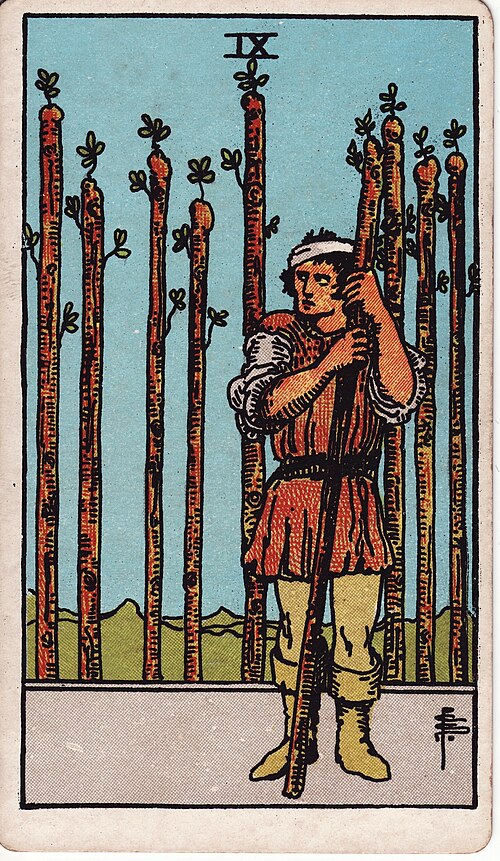
Nine of Wands at a Glance
Card: Nine of Wands. Group: Minor Arcana, Wands suit. RWS rank: Nine. Position: 31 of 78, following the Eight of Wands and preceding the Ten of Wands. The card concentrates on persistence after strain, cautious readiness, and the question of how to protect a hard-won position without living permanently on alert.
The Wands suit is commonly used to organize action, drive, creative effort, and competition. A single card does not guarantee an event or reveal an objective future. Read the Nine of Wands as a symbolic prompt: notice what has tested you, what remains available, and which boundary or recovery step would make the next action sustainable.
RWS Image: A Guarded Figure
In the Rider-Waite-Smith image, one figure stands in the foreground holding a wand upright. A bandage is visible around the head, and the figure's posture is wary rather than relaxed. Eight more wands stand behind him in a close row, forming a rough visual barrier. The figure and the row are set against an open yellow-green landscape with distant blue-gray hills and a pale sky. His body and gaze angle toward the side, as if attention is directed to what may approach rather than to celebration.
These are observations before interpretation. The head bandage visibly suggests recent wear or injury as an image motif, while the upright wand and barrier suggest preparedness in traditional and modern symbolic readings. The repeated vertical lines create structure and defense; the open distance leaves room for movement, but the figure is still at the threshold of deciding whether to continue, retreat, or reset. Color, terrain, and posture therefore support a reading about endurance under conditions that are not entirely comfortable.
Keywords and How They Follow from the Image
- Resilience: the standing figure remains present after visible strain. Boundaries: the eight wands behind him mark a protected edge. Preparedness: the held wand and sideward attention suggest readiness rather than passive waiting. Vigilance: the guarded posture keeps watch for another challenge. Recovery: the bandage makes rest and repair part of the meaning, not an afterthought. Persistence: the card sits late in the numbered Wands sequence, where sustained effort is being tested before completion. These keywords are interpretive tools drawn from the image's repetition, posture, and suit tradition, not fixed predictions.
Upright Nine of Wands Meaning
Upright, the Nine of Wands describes a person or process that has already used significant energy and still has a final stretch to manage. Its strength is durable commitment: experience has taught you what to watch, where your limits are, and which protections are useful. The card can support a careful continuation, a firm boundary, a final review, or a decision to conserve energy until the next step is clear.
Its risk is excess. Caution can become suspicion, a boundary can become isolation, and perseverance can become an identity built around struggle. The card does not say that you must endure everything simply because you have endured much already. A practical action is to inventory evidence, resources, support, and remaining tasks. Define what would count as enough, schedule recovery, and distinguish a real present risk from a familiar fear carried over from an earlier experience.
Reversed Nine of Wands Meaning
Reversed, the card may show blockage when fatigue, fear, or an unclear boundary prevents a useful next move. It may point to internalization: the person keeps all strain private and refuses support even when help is available. Excess can appear as hypervigilance, defensive reactions, repeated checking, or treating every question as an attack. Delay may arise because an old setback is being replayed before any new evidence is considered.
Reversal is not automatically negative. It can describe a deliberate pause, a private recovery phase, or the healthy recognition that a defensive pattern has become costly. Direction adjustment means lowering the guard selectively, changing the plan, asking for assistance, or ending a task that no longer deserves more effort. Ask which part of the card is needed now: protection, rest, information, a clearer limit, or permission to move on. Upright does not guarantee a positive outcome, and reversed does not guarantee failure.
Applications in Life Areas
- Relationships and emotions: The card can describe loyalty after difficulty, a need for reassurance, or a relationship where one person remains guarded. Name the boundary and the feeling beneath it rather than testing the other person. In a healthy context, persistence includes repair
- in an unhealthy context, it does not require tolerating harm. Do not use the card to claim certainty about another person's thoughts.
- Work and study: Continue a demanding project with a short, realistic finish line. Review risks, protect concentration, and request practical support. Reversed, burnout, perfectionistic checking, or fear of repeating an earlier mistake may delay submission or decision-making
- a smaller milestone can restore movement.
- Money and resources: Treat this as a prompt for a reserve, a budget review, and risk limits rather than a promise of financial security. Upright may favor protecting existing resources while completing a plan. Reversed may suggest scarcity anxiety, defensive spending, or postponing a necessary review
- use current records and qualified advice for consequential choices.
- Personal growth: Learn the difference between resilience and self-abandonment. Track the lesson from a difficult experience, but do not make the wound the whole identity. Growth may involve practicing a boundary, resting without guilt, or testing whether the present really matches the past.
Nine of Wands in Tarot Spreads
One-card prompt: “What deserves protection, and what would make my next step sustainable?” The card emphasizes stamina and boundaries, but the answer should come from the question and observable circumstances, not from a fixed yes or no. In a one-card daily draw, record the evidence that supports caution and the evidence that supports openness.
- Three-card past, present, future: In the past, the Nine of Wands can show a previous challenge that shaped current defenses. In the present, it highlights readiness, fatigue, or a final review. In the future, it suggests that persistence may be useful, while also asking what recovery and support must be arranged before continuing.
- Three-card situation, action, outcome: As situation, it frames the matter as a late-stage test or guarded environment. As action, it recommends a clear limit, preparation, and measured effort. As outcome, it does not promise victory
- it shows the likely emphasis of finishing carefully, learning from strain, or recognizing when persistence has reached its limit.
- Relationship positions: For self, read the figure as your defenses, endurance, or need for repair. For the other person, read it as the role that caution or past experience may be playing in the interaction, not as a claim about their private mind. For interaction, examine whether the shared pattern is mutual protection, repeated testing, or a boundary that needs explicit language.
- Decision positions: In opportunity, the card may show a chance to consolidate progress or complete a meaningful final stage. In risk, it warns that fear, fatigue, or defensiveness may narrow your view. In advice, it favors preparation and selective protection rather than either reckless exposure or total withdrawal.
- Obstacle, advice, outcome: As obstacle, identify exhaustion, mistrust, or an inherited defensive habit. As advice, clarify the limit, gather support, and schedule recovery. As outcome, read the card as a guarded continuation or a conscious choice to stop
- surrounding cards and real-world evidence decide which emphasis is stronger.
Instructional Combination Example
Instructional example, not a real case: Eight of Wands beside the Nine of Wands can turn rapid movement into a question about capacity, suggesting that messages or opportunities are arriving faster than the querent can process them. The Nine beside the Ten of Wands can shift persistence toward burden management: finish the essential task, then remove unnecessary weight. Adjacent cards modify the Nine by showing whether speed, load, support, or release is the practical issue.
Common Misreadings, School Differences, and Responsible Use
A common misreading is “the Nine of Wands means victory is guaranteed because you are almost done.” The image can instead show a need to stop, renegotiate, or recover. Another mistake is treating the bandage as a literal medical diagnosis or the figure as a fixed personality type. Separate visible details, traditional interpretation, and your editorial synthesis. A. E. Waite's The Pictorial Key to the Tarot is a historical source associated with the 1911 publication context and was illustrated by Pamela Colman Smith; later psychological, intuitive, and esoteric schools add their own methods. No later association should be presented as the only historical meaning.
RWS and Marseille traditions differ in some imagery and in the numbering of Strength and Justice: RWS uses Strength VIII and Justice XI, while Marseille commonly uses Justice VIII and Strength XI. This series follows RWS numbering and gives primary attention to RWS imagery. Some readers do not use reversals, while others read them as blockage, internalization, excess, delay, or direction change. Choose a consistent method and state it.
Tarot is a cultural and symbolic-reading practice that can support reflection; it has no scientifically validated power to predict events. Do not use this card as medical, legal, investment-return, or guaranteed-fate advice. Do not use it to read a third party's mind or to justify coercion, surveillance, or dependency. For high-stakes decisions, consult appropriate qualified professionals and use current evidence.
Tarot Journal Prompts
- Where am I prepared because of present evidence, and where am I reacting to an older experience?
- Which boundary would protect my energy without cutting off useful support?
- What is the smallest sustainable action that would move this situation forward?
Suggested Learning Links
- Previous card: Eight of Wands, tarot-card-eight-of-wands. Compare its open speed with the Nine's guarded pacing.
- Next card: Ten of Wands, tarot-card-ten-of-wands. Continue the Wands sequence by examining how persistence can become load.
- Foundational tarot articles: Wands suit guide, tarot-wands
- Tarot for Beginners, tarot-for-beginners
- Upright and Reversed, tarot-upright-and-reversed
- Three-Card Tarot Spreads, three-card-tarot-spreads
- and Tarot Journal Review, tarot-journal-review.