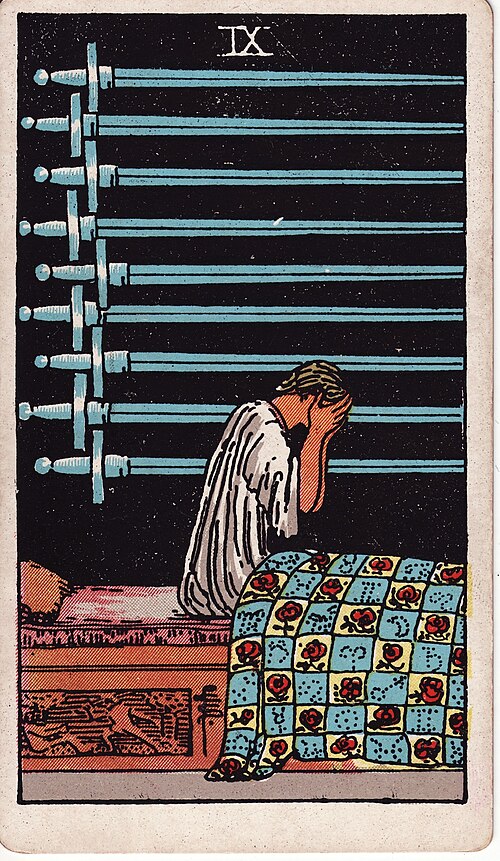
Nine of Swords at a Glance
The Nine of Swords is Minor Arcana, Swords suit, rank nine, and position 59 in this 78-card RWS series. Swords are commonly used to organize thought, language, judgment, boundaries, and conflict; the number nine brings a theme close to completion while still holding tension before the ten-card conclusion. The card is therefore a focused image of mental pressure, private fear, remorse, or a story that becomes louder in solitude. It is a symbolic reading prompt, not a diagnosis or a promise that a feared event will occur.
RWS Image: What Is Visible
In the RWS scene, a seated figure bends forward on a bed with their head in their hands. The face is largely hidden, so the image does not identify a gender or prove a particular cause of distress. Nine swords run horizontally across the dark wall behind the figure. The bedspread is dark and patterned with repeated red rose forms and zodiac-like emblems, while the figure's clothing is pale against the shadowed room. The downward posture, inward gaze, confined background, and repeated blades create a strong contrast with cards that show open travel or public action. No attacker, monster, or external event is visibly present; the picture centers on an experience of thought in a private room.
Those details support a careful distinction between observation and interpretation. The swords are visible objects, while anxiety, guilt, insomnia, and catastrophic thinking are traditional and modern interpretive possibilities. The scene can also describe the period before a person speaks, checks the facts, asks for support, or notices that an internal narrative has become disproportionate to current evidence.
Keywords from the Image and Tradition
- Mental pressure and worry follow from the bowed figure and closed room
- nighttime rumination follows from the private, shadowed setting
- remorse and difficult thoughts are traditional uses of the swords as a thinking and judgment suit
- isolation follows from the absence of another visible person
- perspective adjustment follows because the card shows an experience of fear, not proof that fear is accurate
- compassion and support remain available because the image does not show an unavoidable external sentence.
Upright Meaning: Pressure That Wants Attention
Upright, the Nine of Swords can describe a mind caught in repetition: replaying a conversation, rehearsing a feared outcome, or turning one unresolved issue into a total judgment of the self. Its strength is diagnostic in the ordinary sense of noticing a problem clearly, not medical diagnosis. The card may bring an uncomfortable truth into awareness so that it can be named, checked, and addressed. It can also represent conscientiousness, moral reflection, and the willingness to admit that a thought pattern is costing rest or agency.
The risk is treating intensity as evidence. A vivid nightmare, a guilty feeling, or a string of imagined consequences may deserve care without being a reliable forecast. Excess can appear as self-punishment, secrecy, doom-scrolling, repeated reassurance-seeking, or making a major decision at the peak of fear. The practical upright response is small and verifiable: write down the fear, separate facts from predictions, identify what is within control, and choose one conversation, boundary, appointment, study step, or rest practice that reduces avoidable pressure.
Reversed Meaning: Changing the Relationship to Fear
Reversed, the Nine of Swords does not automatically mean that everything is fine or that the difficulty is worse. It may show blockage when worry cannot be spoken, internalization when the person hides distress behind a competent exterior, excess when self-criticism becomes relentless, delay when an overdue conversation or practical check is postponed, or direction adjustment when the mind needs a different method rather than another round of analysis. It can also indicate that a difficult cycle is beginning to loosen, especially when the surrounding cards show support and concrete action.
- For blockage, ask what cannot yet be named. For internalization, ask what support could be safely invited. For excess, reduce the habit that feeds the loop and use a time limit for analysis. For delay, set a modest next step with a real date. For direction adjustment, test a fact-based alternative to the current story. In every case, read the surrounding cards and the position before deciding whether the emphasis is concealment, release, or recovery.
Applications in Life Areas
In relationships and emotions, upright may describe fear of rejection, guilt after conflict, or a private emotional burden that has not been communicated. It does not prove that another person is betraying, judging, or secretly suffering. Reversed may suggest that a person is beginning to disclose what has been held inside, or that avoidance is keeping the relationship in a delayed conversation. A useful action is to speak from observable facts and personal experience rather than making claims about someone else's mind.
For work and study, the card can point to deadline anxiety, perfectionism, fear of evaluation, or a mistake that is receiving more mental space than its practical repair requires. Its constructive side is careful review: make a checklist, request clear criteria, correct what can be corrected, and stop after the agreed standard is met. Reversed may show procrastination through worry, hidden burnout, or a gradual return to a manageable routine.
For money and resources, the Nine of Swords highlights financial fear, regret over a purchase, or uncertainty amplified by incomplete information. It is not a promise of loss or a substitute for budgeting, qualified advice, or contract review. List actual balances, deadlines, options, and questions; then make decisions from verified numbers. Reversed can mark avoidance of a statement or a first step toward facing it.
For personal growth, the card invites honest attention to the inner critic and to the difference between responsibility and punishment. Journaling, trusted conversation, sleep-supporting routines, and professional help when distress is persistent may all be appropriate. Tarot can help frame reflection, but it cannot diagnose a mental-health condition or replace care from a qualified professional.
Reading the Nine of Swords in Spreads
In a one-card prompt, ask: What thought is demanding attention, and what fact or action can I check today? The emphasis is on a usable response, not on predicting a nightmare. In a three-card past, present, future spread, the past position may show the origin of a worry or a previous judgment; the present may show how the thought loop is operating now; the future position suggests a possible direction if the querent responds, not an unavoidable outcome. In a situation, action, outcome spread, it can describe the mental climate, recommend fact-checking and support, and show the likely effect of continuing either avoidance or practical care.
In relationship positions, Nine of Swords as self can describe the reader's fear, guilt, or unspoken concern; as the other person, it is safer to read it as the role or pressure represented in the spread rather than a claim about that person's private mind; as interaction, it may show a feedback loop in which silence and assumption intensify one another. In decision positions, as opportunity it may offer a chance to name a hidden concern and prepare well; as risk it warns against choosing from panic; as advice it recommends a bounded, evidence-based next step.
As obstacle, the card can show rumination, shame, or fear of being judged. As advice, it asks for compassionate clarity, support, and a distinction between facts and imagined outcomes. As outcome, it describes the mental or emotional emphasis likely to follow the current pattern; it is not a fixed fate and should be read with the surrounding cards and real-world choices.
Instructional Combination Reading
Instructional example, not a real case: Eight of Swords beside the Nine of Swords can move from a visible feeling of restriction into the private mental cost of that restriction, so the pair invites examination of both circumstances and interpretation. The Nine beside the Ten of Swords can show a worry reaching a clear endpoint or a painful conclusion becoming impossible to ignore; it still does not predict literal harm. A neighboring card that offers support, communication, or a new inquiry can change the emphasis from isolation toward a concrete response.
Common Misreadings, Schools, and Responsible Use
A common misreading treats the Nine of Swords as proof of disaster, punishment, illness, or a literal night event. Another turns the seated figure into a fixed personality label. The image supports a theme of mental burden; the question, position, nearby cards, and lived evidence determine how specifically it applies. Some readers use reversals, while others read every card upright and let position and context supply the shadow expression. Both methods can be coherent when used consistently.
This series uses the RWS order and primary image analysis. RWS and Marseille traditions differ in some imagery and in the numbering of Strength and Justice: RWS places Strength at VIII and Justice at XI, while Marseille commonly places Justice at VIII and Strength at XI. Marseille-style numbered Swords cards often provide pips rather than the RWS illustrated scene, so their visual evidence and interpretive emphasis can differ. Historically, A. E. Waite's 1911 The Pictorial Key to the Tarot credits Pamela Colman Smith for the illustrations; it is an important source for the RWS-era tradition, not a scientific validation of predictive claims.
Read the Nine of Swords as a prompt to examine pressure, evidence, and support—not as permission to treat fear as fact.
Tarot Journal Prompts
- What is the clearest fact in the situation, and what part is prediction or self-judgment? What small action would reduce avoidable pressure without demanding certainty? Where could I ask for support while respecting privacy and consent? What did I learn after recording the card, my action, and the later observable result?
Suggested Learning Links
Continue with the previous card, Eight of Swords (tarot-card-eight-of-swords), and the next card, Ten of Swords (tarot-card-ten-of-swords). For foundations, see Tarot for Beginners (tarot-for-beginners), Tarot Upright and Reversed (tarot-upright-and-reversed), Three-Card Tarot Spreads (three-card-tarot-spreads), Tarot Swords (tarot-swords), and Ethics and Boundaries (ethics-and-boundaries). These resources support structured reflection without replacing professional, financial, legal, or medical advice.