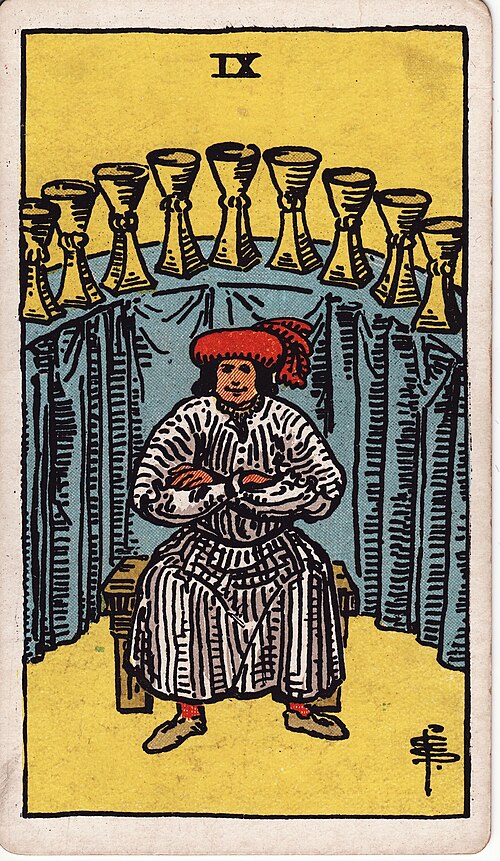
Nine of Cups at a glance
The Nine of Cups is Minor Arcana, Cups, rank nine, and position 45 in this 78-card RWS sequence. It follows the Eight of Cups and precedes the Ten of Cups. The card is often read through satisfaction, enjoyment, and emotional self-possession, but a spread position decides whether its emphasis is fulfillment, a pause to appreciate what is present, or a warning that comfort has become complacency.
Rider-Waite-Smith means the illustrated deck tradition associated with A. E. Waite and Pamela Colman Smith. The sequence used here follows RWS numbering and imagery. Marseille traditions differ in some imagery and in the numbering of Strength and Justice, so comparisons should be labeled rather than blended into one supposedly universal system.
What the RWS image shows
A single seated figure faces the viewer from the foreground. His arms are folded across his body, and his expression appears pleased or self-satisfied. Behind him, nine golden cups are arranged in a clear row on a raised, draped surface. The cups form the strongest horizontal structure in the scene, while the blue-gray background and muted ground keep attention on the person and the displayed vessels. The figure's red and blue clothing adds contrast to the repeated gold cups.
The image does not show a crowd, a shared meal, or an obvious exchange. It shows one person with visible possessions or symbols of emotional value placed behind him. That arrangement supports a reading of private satisfaction and appraisal. Traditional interpretations may extend the scene into a wish fulfilled or a pleasant result, but those are interpretive uses, not observable facts and not guarantees about future events.
Keywords derived from the image
The useful keyword set is satisfaction, gratitude, pleasure, emotional independence, wish, and complacency. Satisfaction follows from the figure's relaxed, self-contained posture and the orderly display behind him. Gratitude and pleasure are modern reflective applications of having enough to notice and enjoy. Emotional independence comes from the absence of a second figure or visible dependence. Wish points to traditional tarot language about a desired result. Complacency is the shadow keyword: folded arms and a display can also suggest stopping at the appearance of success instead of asking what still needs care.
Upright Nine of Cups meanings
Upright, the Nine of Cups highlights a moment when a desire, need, or emotional aim has reached a satisfying checkpoint. Its strength is not endless acquisition but the ability to recognize a result and let it register. It can support self-trust, pleasure without apology, honest celebration, and a realistic inventory of what is already working. In a reading, ask what kind of satisfaction is actually present: bodily ease, emotional relief, social approval, or the completion of a specific task.
The risk of excess is indulgence, self-absorption, or confusing a polished surface with deep well-being. A practical action is to name the result, record the effort that produced it, and choose one way to share or sustain it without turning gratitude into performance. If the card appears as advice, enjoy the evidence of progress before adding another demand. Upright does not promise a favorable outcome; it describes a useful stance or a pattern that may need context from surrounding cards.
Reversed Nine of Cups meanings
Reversed, the card can describe blockage when the questioner cannot acknowledge a real gain, or internalization when satisfaction is kept private and becomes hard to communicate. It may show excess through overconsumption, approval-seeking, fantasy, or using pleasure to avoid a difficult need. Delay can arise when a desired result is close but the underlying conditions have not been checked. Direction adjustment means moving from "How can I get more?" to "What would make this result meaningful, durable, and shared appropriately?"
A reversed card is not automatically negative. It may be a quiet invitation to revise the definition of success, reduce comparison, or admit that an impressive outcome does not feel nourishing. In a practical reading, separate three questions: what is missing, what is being exaggerated, and what can be verified now. The answer may be rest, a clearer boundary, a modest request, or a delayed celebration rather than a dramatic reversal.
Applications in ordinary life
In relationships and emotions, upright Nine of Cups can emphasize enjoying companionship while remaining a whole person, receiving affection, or noticing that an emotional need has been met. It does not prove what another person thinks. Reversed, it may point to an unspoken expectation, emotional self-protection, performative happiness, or a relationship in which comfort masks avoidance. Ask for direct communication and observable behavior rather than treating the card as a verdict about a partner.
For work and study, upright suggests a completed milestone, confidence earned through practice, or permission to acknowledge competence. The risk is resting on praise and skipping the next review. Reversed can show a delayed reward, an achievement that does not match the original goal, or motivation tied too tightly to approval. Break the next step into a measurable task and check whether the target still matters.
For money and resources, the card can support a modest enjoyment of resources, a budgeted reward, or recognition that stability is more useful than endless accumulation. It is not investment-return advice and cannot guarantee profit. Reversed may signal lifestyle inflation, emotional spending, or dissatisfaction despite adequate resources. Use a written budget, cooling-off period, and qualified financial guidance for consequential decisions.
For personal growth, the Nine of Cups asks whether you can receive your own progress without minimizing it or making it your entire identity. Upright practice is appreciation with proportion. Reversed practice is honest auditing: identify the feeling you hoped an external achievement would provide, then find a grounded way to meet that need. Neither orientation replaces mental health care or other professional support when that is needed.
The Nine of Cups in spreads
In a one-card reading, use it as a prompt to ask, "What is enough for today, and how will I recognize it?" In a three-card past, present, future spread, the past position may show an earlier satisfaction or expectation shaping the question; the present position may identify what can be appreciated or where comfort has narrowed awareness; the future position suggests a possible emotional direction, not a fixed promise. In a situation, action, outcome spread, it can describe the emotional climate, recommend a measured act of appreciation, or show the quality of a result that still depends on choices.
In relationship positions, Nine of Cups as self may describe your current need for contentment or independence. As the other person, it can represent the role the person seems to occupy in the question, but not their private thoughts; verify through conversation. As interaction, it asks whether the bond creates mutual enjoyment or merely lets each person stay comfortable alone. In decision positions, opportunity is a chance to consolidate a desired gain, risk is overindulgence or wishful thinking, and advice is to define satisfaction before choosing.
As obstacle, the card can show reluctance to leave a comfortable position or an unexamined attachment to praise. As advice, it recommends appreciation, honest self-assessment, and a proportionate reward. As outcome, it describes a possible experience of satisfaction if the surrounding evidence and actions support it; it is not a guarantee. Always let the question, neighboring cards, orientation method, and real-world facts change the emphasis.
Instructional combination example
Instructional example, not a real case: Eight of Cups beside the Nine of Cups can shift the reading from simple pleasure to the satisfaction that becomes possible after leaving an emotionally stale arrangement. If the Nine of Cups is beside the Ten of Cups, private contentment may broaden into shared belonging, while the pair can also warn against idealizing a perfect emotional picture. The adjacent card supplies context; neither combination predicts a guaranteed event.
Misreadings, deck differences, and responsible use
A common misreading is treating the Nine of Cups as an automatic "yes," guaranteed wish fulfillment, or proof that a person is selfish. The RWS scene is a visual prompt, not a diagnosis. Waite's Pictorial Key to the Tarot is a historical interpretive source; the 1911 source record identifies Arthur Edward Waite as author and Pamela Colman Smith as illustrator. This article separates that historical layer from observable imagery and modern reflective synthesis. Marseille pip cards use different visual conventions, and other decks may change the figure, arrangement, or emphasis. Strength and Justice also trade numbers between RWS and Marseille traditions, which is why this series explicitly follows RWS.
Use tarot for cultural study, symbolic reading, and self-reflection. Do not use a card to read a third party's mind, make medical or legal decisions, direct investments, or promise a predetermined fate. For high-stakes choices, pair reflection with evidence, consent, qualified advice, and the freedom to change course.
Tarot journal prompts
- 1. What result or feeling am I calling a success, and what evidence supports that description? 2. Where does comfort help me recover, and where might it keep me from an honest conversation? 3. What can I appreciate without turning appreciation into a demand for more?
Suggested learning links
Continue backward with Eight of Cups at tarot-card-eight-of-cups and forward with Ten of Cups at tarot-card-ten-of-cups. For foundations, see tarot-cups, tarot-for-beginners, tarot-upright-and-reversed, three-card-tarot-spreads, tarot-how-to-ask, tarot-journal-review, and ethics-and-boundaries. For historical comparison, consult The Pictorial Key to the Tarot at https://sacred-texts.com/tarot/pkt/index.htm.