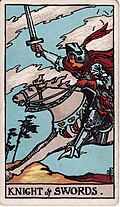
Knight of Swords at a glance
The Knight of Swords is a Minor Arcana court card, the twelfth card of the Swords suit and position 62 in this site's 78-card Rider-Waite-Smith (RWS) sequence. It concentrates the suit's thinking, language, judgment, and conflict into rapid movement. The Knight may describe decisive action, a forceful message, a demanding pursuit, or the need to move from analysis into implementation. It does not guarantee victory, and it is not automatically a literal young man.
This series uses the RWS sequence and primary image analysis. RWS places Strength at VIII and Justice at XI; many Marseille traditions place those two Major Arcana numbers in the opposite order and use different imagery, especially for the Minor Arcana. The familiar RWS deck was published by William Rider & Son in 1909, with Pamela Colman Smith's scenes created under A. E. Waite's direction. Historical context, traditional interpretation, and modern self-reflection are different layers. Tarot here is a symbolic reading practice, not a scientifically validated prediction system.
Visible RWS imagery
An armored rider leans forward on a white horse whose front legs are raised as it charges across the scene. The rider holds a sword high and forward, making the blade the clear directional line of the image. A red cloak and plume stream backward in the wind. The sky is yellow and active; trees bend and clouds move, while the ground and distant landscape recede behind the rush. The horse's exposed motion communicates momentum, but the image offers little sign of braking or careful preparation. These visible elements support speed, courage, urgency, direct speech, and the question of whether force has outrun judgment.
Keywords and how the image produces them
The concise keyword set is speed, decisiveness, direct communication, pursuit, intellectual force, and urgency. The charging horse supplies momentum; the lifted sword turns thought or language into a pointed act; the armor suggests readiness for contest; and the wind-blown cloak and trees show an atmosphere already being disturbed by movement. Traditional court-card reading adds the Knight's mobile, developing expression of the Swords suit. The keywords therefore arise from the pictured action, the suit's conventional field of meaning, and the rank's role. They are interpretive tools, not fixed forecasts.
- Speed follows the horse's charge
- decisiveness follows the forward-pointing blade and rider
- direct communication follows the exposed sword and Swords tradition
- pursuit follows the image's single direction
- intellectual force follows the suit
- urgency follows the wind, raised legs, and lack of visible pause.
Upright Knight of Swords meaning
Upright, the Knight of Swords can be the energy needed to make a clear decision, send the important message, defend a principle, or begin a difficult piece of work. Its strength is focused courage: identify the central issue, state the aim, and act while the path is sufficiently clear. It can support debate, advocacy, a deadline, intensive study, or a rapid response to changing information. The best version of this Knight is not reckless; it is prepared enough to move with purpose.
The risk of excess is haste. Speed can become interruption, aggression, overconfidence, burnout, or a crusade against anyone who does not share the rider's conclusion. A correct insight delivered without timing or care may still damage trust. Practical action is to define the decision, check the highest-cost assumption, choose a stopping point, and tell affected people what is changing. Use the card's force to remove avoidable delay, not to erase consent, nuance, or the evidence that might alter your plan.
Reversed Knight of Swords meaning
Reversed, this card is not automatically a defeat or a sign of violence. It can show blocked momentum, an internalized argument, or a powerful idea that has nowhere safe and useful to go. Excess may appear as reckless speech, hostile debate, impulsive travel, overwork, or acting on a rumor. Delay can arise from missing information, a poorly chosen channel, fear of consequences, or a plan that was launched before the logistics were ready. The rider may be moving fast but not truly advancing.
Direction adjustment means applying brakes without abandoning the objective. Separate urgency from emergency, verify the message, and replace a sweeping claim with one testable statement. If anger is internalized, write the argument privately before sending it and decide what outcome you actually want. If work is stalled, reduce the mission to the next safe step and identify who must be informed. A reversed Knight can also describe constructive containment: postponing a confrontation, editing a sharp reply, or redirecting energy into disciplined research.
Applications in ordinary life
In relationships and emotions, the Knight can indicate a candid conversation, a sudden change of pace, passionate argument, or someone acting from conviction. Upright, say the difficult thing plainly and make room for the other person's response. Reversed, watch for point-scoring, angry messages, premature ultimatums, or interpreting intensity as intimacy. The card cannot reveal what another person secretly thinks. It can help you examine your own communication, boundaries, and willingness to repair after speaking sharply.
In work and study, the card favors deadlines, advocacy, presentations, research sprints, competitive environments, and turning a conclusion into a deliverable. Its weakness is skipping review or leaving collaborators behind. For money and resources, it recommends checking contracts, timelines, and downside exposure before acting on a fast opportunity; it is not a promise of returns and should not substitute for professional financial advice. For personal growth, practice assertiveness with recovery: act clearly, then review the effects rather than treating momentum as proof of wisdom.
Knight of Swords in spreads and positions
In a one-card reading, ask: “Where is decisive action useful, and where do I need a brake?” The card may emphasize an urgent conversation, a deadline, a boundary, or a plan that needs implementation. In a three-card situation, action, outcome spread, the situation is the pressure or argument already in motion; action is the clearest responsible intervention; outcome is the likely consequence of the chosen pace and communication, not a guaranteed future. Read the surrounding cards for whether speed becomes progress or collateral damage.
- Relationship — self: examine your pace, tone, and willingness to listen
- other person: read a visible role or behavior, not private motives
- interaction: assess whether directness creates movement or escalation. Decision — opportunity: act on a well-defined opening, speak up, or cut through confusion
- risk: haste, conflict, and ignored logistics
- advice: verify the key fact, then move. Obstacle: impatience, anger, or a delayed channel. Advice: set a clear objective and a stopping rule. Outcome: a decisive next stage or a useful lesson about timing, never a guaranteed result.
Instructional combination reading
Instructional example, not a real case: Page of Swords beside Knight of Swords. The Page contributes observation, a question, or a first piece of information; the Knight turns that material into a rapid message or action. In a constructive reading, careful research leads to a timely proposal. In a warning reading, an unconfirmed comment becomes an aggressive conclusion. With the Knight reversed, the Page may need to keep gathering facts; with the Page reversed, the Knight's speed should be reduced until the source and intended outcome are clear.
Let the Knight accelerate a sound decision, not convert urgency into a reason to stop listening.
Common misreadings, deck differences, and responsible use
The Knight is not automatically a reckless man, a hostile stranger, or a promise that an event will happen quickly. Court cards can describe a role, phase, method, or part of the querent's conduct, independent of gender and age. Marseille decks generally present numbered Swords pips rather than the RWS charging scene, and other decks may change the horse, armor, direction, or emotional tone. Reversal systems also vary. A reader should name the deck and method rather than treating one school as universal.
Use this card for symbolic learning, self-reflection, and practical question design. Do not use it to read a third party's mind or to make medical, legal, investment-return, or guaranteed-fate claims. For consequential choices, use qualified professional advice, consent, ordinary evidence, and a realistic risk check. A tarot prompt can help you choose a conversation or review a plan; it cannot authorize coercion, unsafe action, privacy violations, or certainty about another person's future.
Tarot journal prompts
- What decision is genuinely time-sensitive, and what can wait for one more check?
- Where has my speed helped, and where has it made listening harder?
- What exact message or action would express my principle without escalating the conflict?
- What stopping rule will tell me to review the plan?
Suggested learning links
Read Page of Swords (tarot-card-page-of-swords) as the previous card and Queen of Swords (tarot-card-queen-of-swords) as the next card in the sequence. For foundations, use the Swords suit guide (tarot-swords), Tarot for Beginners (tarot-for-beginners), the Court Cards guide (tarot-court-cards), Upright and Reversed Tarot (tarot-upright-and-reversed), How to Ask Tarot Questions (tarot-how-to-ask), the Three-Card Tarot Spreads guide (three-card-tarot-spreads), and Tarot Journal Review (tarot-journal-review).