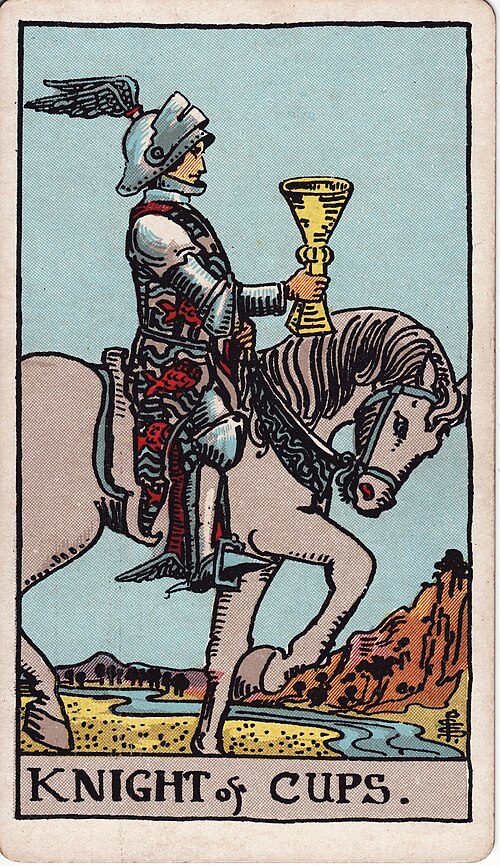
Knight of Cups: identity and place in the RWS sequence
The Rider-Waite-Smith (RWS) Knight of Cups is the twelfth card of the Cups suit, after the Page of Cups and before the Queen of Cups. It is Minor Arcana card position 48 in this site's 78-card order. As a court card, the Knight is not a fixed prediction about a man or a romantic partner. It can describe movement, pursuit, a messenger who takes feeling into the world, or a stage in which an idea is being carried toward an encounter.
This article uses the RWS image, traditional tarot commentary associated with A. E. Waite, and practical reflective methods to build an original interpretation. Tarot is a cultural and symbolic tool, not a scientifically validated forecasting system. The Knight can help a reader examine motives, communication, and next steps, but it cannot guarantee romance, establish another person's intentions, or replace evidence and professional advice.
What is visible in the RWS image
An armored knight sits on a white horse and holds a cup forward in one hand. In the familiar RWS image, horse and rider face toward the left side of the card, while the offered cup gives the movement a clear destination and purpose. The horse lifts one foreleg rather than charging at full speed. Blue-gray armor, a flowing blue cloak, and winged details on the helmet or footwear add a visual language of air and imagination to the watery suit.
A river or stream runs through the landscape, with green ground, trees, distant hills, and a pale open sky. The horse's light color contrasts with the darker water and earth, making the rider's controlled approach easy to notice. The cup is held outward, not hidden. That visible action supports an interpretation of feeling becoming a proposal, invitation, artistic offering, or stated value. Yet the measured horse also suggests that sincerity and speed are not the same thing.
The RWS and Marseille traditions differ in imagery, minor-card structure, and several Major Arcana conventions. In particular, RWS numbers Strength as VIII and Justice as XI, while Marseille commonly places Justice at VIII and Strength at XI. This series follows RWS numbering and analyzes the illustrated RWS scene. A Marseille or another deck may use a different image and therefore invite a different emphasis, even when the card name is the same.
Keywords and how the image supports them
The most useful keywords are invitation, pursuit, idealism, emotional expression, diplomacy, and directed imagination. Invitation follows from the cup extended toward another person or destination. Pursuit comes from the mounted figure's travel. Idealism is supported by the decorative, almost airborne details and the open landscape, but it is also a caution. Emotional expression is visible in the offered vessel; diplomacy in the non-aggressive posture; and directed imagination in carrying a feeling toward a chosen encounter.
Upright Knight of Cups meanings
Upright, the Knight of Cups describes a feeling that is ready to move: a proposal, a thoughtful message, an artistic presentation, a diplomatic approach, or a journey shaped by values. Its strength is the ability to make emotion communicable without treating it as weakness. It can encourage tact, beauty, empathy, and a clear invitation. The card asks what you are offering, to whom, and whether your action can support the feeling you express.
- Potential strengths: persuasive kindness, creative momentum, tactful negotiation, romantic or artistic initiative, and the courage to make a sincere offer.
The excess is performance without follow-through. A polished message can hide uncertainty, and an idealized pursuit can overlook practical limits or the other person's consent. Upright does not mean a proposal will be accepted or a dream will come true. Match the gesture to the commitment you can keep. Put dates, costs, responsibilities, and expectations into plain language when the situation needs more than atmosphere.
Reversed Knight of Cups meanings
Reversed, the Knight of Cups can indicate blocked movement, a feeling that remains internal, emotional excess, delay, or a change of direction. The blockage may be fear of rejection or difficulty turning inspiration into a concrete offer. Internalization can look like rehearsing a conversation without having it. Excess may appear as seduction, melodrama, escapism, or promises larger than capacity. Delay can be useful if motives are unclear; it can also protect avoidance.
- Reversal lenses: blockage when the offer cannot be made
- internalization when the imagined dialogue replaces communication
- excess when charm outruns responsibility
- delay when timing or consent is unresolved
- direction adjustment when the pursuit should become a grounded plan, a boundary, or a graceful withdrawal.
To adjust direction, slow the horse down. Check whether the offer is specific, wanted, affordable, and realistic. Replace a sweeping promise with one verifiable step, and distinguish a private fantasy from a shared agreement. If a message is delayed, set a reasonable time to revisit it rather than sending repeated emotional appeals. Reversed can therefore mark a needed pause, not simply failure or bad character.
Applications in everyday life
Relationships and emotions: upright, the Knight may support a direct invitation, a heartfelt conversation, courtship, reconciliation efforts, or a shared creative experience. It describes an approach, not a guaranteed relationship. Keep the other person's autonomy visible. Reversed, examine mixed signals, romantic projection, emotional pressure, avoidance, or a pattern of grand gestures followed by silence. Ask for direct information instead of using the card to infer a third party's feelings.
Work and study: the card can favor pitching an idea, presenting creative work, negotiating with tact, applying for a role aligned with values, or learning through a mentor who communicates with care. Its moving horse encourages delivery, not endless preparation. Reversed, an attractive concept may lack a schedule, or a student may wait for inspiration. Define the next deliverable, request feedback, and keep the emotional appeal connected to competent execution.
Money and resources: the Knight can point to a values-based offer, a creative service, travel connected with work, or a decision motivated by quality rather than status. It is not a sign of guaranteed profit. Check the numbers behind any appealing proposal. Reversed, watch for impulse purchases, persuasive sales language, vague terms, or spending to sustain a fantasy. Use a budget, written agreement, and qualified financial guidance where appropriate.
Personal growth: practice moving from feeling to responsible expression. Ask whether your ideal is a direction, a relationship to reality, or an escape from an uncomfortable fact. Upright, let imagination guide a small act of creation or connection. Reversed, examine whether you are waiting to feel perfectly ready, using charm to avoid accountability, or pursuing an image that no longer fits. Growth is emotional honesty plus disciplined follow-through.
The Knight of Cups in spreads
One-card prompt: ask, “What am I being invited to offer, and what would responsible follow-through require?” Upright may emphasize a sincere approach or creative motion; reversed may emphasize a pause, a clearer boundary, or a need to turn a dream into a practical brief. The position frames the question; the card does not issue an unavoidable command.
In a three-card past, present, future spread, the Knight can show a past pursuit, a present invitation, or a future phase of carrying a value into action. In a situation, action, outcome spread, it may describe an emotionally charged situation, advise a tactful and specific approach, and make the outcome depend on consent, timing, and consistency. Do not read the future position as a promise that the offer will be accepted.
In relationship positions, Knight of Cups in self can describe the querent's style of approach, desire, or readiness to communicate. In the other-person position, it describes the role that pursuit or emotional presentation plays in the spread, not a private mental state. In the interaction position, it may emphasize courtship, a proposal, mediation, or the difference between mutual exchange and one-sided performance. Surrounding cards should test the quality of the offer.
In a decision spread, the Knight as opportunity favors an invitation, creative project, values-led movement, or diplomatic conversation. As risk, it warns of idealization, charm without substance, haste disguised as romance, or neglect of logistics. As advice, offer something clear and proportionate. In obstacle, advice, and outcome positions, it can show emotional performance as the obstacle, a grounded proposal as advice, and an outcome shaped by whether actions match words.
Instructional combination example
Instructional example, not a real case: Page of Cups beside Knight of Cups can show a surprising feeling or message becoming a deliberate invitation. If the next card is Queen of Cups, the sequence may shift from expression toward emotional listening and mature containment. The neighboring cards refine the Knight's direction; they do not prove a romantic event, identify a secret admirer, or guarantee a successful proposal.
Common misreadings, schools, and responsible use
The Knight is not automatically “the perfect lover,” a wedding promise, a literal traveler, or evidence that another person will return. Court cards can represent people, roles, methods, or stages. Some traditions emphasize the Knight's questing energy; others focus on a messenger or emotional offer. Deck artwork changes the evidence available for interpretation, and reversal practices differ. Keep the chosen school, deck, position, and question visible in a journal.
Use the card for cultural learning, symbolic reflection, communication planning, and creative practice. Do not use it to read another person's mind, make medical or legal decisions, promise investment returns, or give guaranteed-fate advice. For safety, consent, health, law, or finances, use qualified human expertise. A responsible reading leaves room for choice and records both confirming and disconfirming feedback instead of treating every later event as proof.
Tarot journal prompts
- 1. What exactly am I offering, and what evidence shows that the offer is wanted and workable?
- 2. Where does my idealistic story help me act, and where does it excuse missing information?
- 3. What small promise can I keep before making a larger emotional or creative commitment?
Suggested learning links
Read the preceding Page of Cups article at tarot-card-page-of-cups, then continue to the Queen of Cups article at tarot-card-queen-of-cups. For foundations, see Tarot for Beginners at tarot-for-beginners, the Cups suit guide at tarot-cups, the upright and reversed method at tarot-upright-and-reversed, the three-card spread guide at three-card-tarot-spreads, the court-cards guide at tarot-court-cards, and the tarot journal review at tarot-journal-review. These resources support method without replacing this card's individual reading.