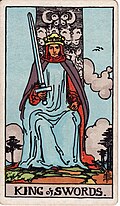
King of Swords: identity and tradition
The King of Swords is the King rank of the Swords suit, a court card in the Minor Arcana and position 64 in the 78-card Rider-Waite-Smith (RWS) sequence. The Swords suit gives form to thought, speech, judgment, boundaries, and conflict; the King expresses those subjects through authority, structure, policy, and accountable decision-making. He may represent a person, a role, a standard, or a mature way of using reason. He is not automatically a literal man, a boss, or a verdict about another person’s character.
The RWS tradition is associated with A. E. Waite’s interpretive work, Pamela Colman Smith’s artwork, and the Rider publishing house, although the deck’s attribution and publication history should not be compressed into a simple creator claim. Waite’s The Pictorial Key to the Tarot provides an important historical lens, while this article separates what the card visibly shows from traditional and modern applications. RWS and Marseille traditions use different imagery and differ in the numbering of Strength and Justice: RWS places Strength at VIII and Justice at XI, while many Marseille-order decks place Justice at VIII and Strength at XI. The series follows RWS numbering.
RWS image: what the card shows
A crowned king sits on a tall gray stone throne beneath a cloudy sky. He holds a sword upright in his right hand, its vertical blade forming a strong central line. His other hand rests lower, on the throne or near his leg, giving the pose a controlled, settled quality. The figure faces forward with a serious expression. Blue clothing, a red outer garment, and a yellow crown create a contrast between cool composure, active authority, and visible rank. The throne includes small decorative motifs, including winged or butterfly-like forms, while the background remains open rather than crowded. These visual observations support traditional themes of order, judgment, and command, but they do not prove that a particular person is fair, powerful, or trustworthy.
Keywords derived from the imagery
- Authority follows from the elevated throne and crown
- reason follows from the centrally held sword and deliberate posture
- accountability follows from the public visibility of the ruler’s decision
- strategy follows from the distant, unobstructed view
- boundaries follow from the blade as a separating line
- and ethical restraint follows from the need to hold power under a clear standard. The King of Swords is therefore less a promise of victory than a prompt to make judgment transparent, proportionate, and answerable.
Upright King of Swords meanings
Upright, the King of Swords supports strategic thinking, fair standards, clear policies, and decisions that can be explained. His strength is disciplined judgment: he can listen, identify the relevant issue, distinguish principle from preference, and act without being swept away by pressure. In work, he can point to leadership, governance, legal or analytical tasks, negotiation, research, or a mentor who teaches a method. In personal matters, he asks for honest agreements and consequences that are understood in advance. The risk of excess is authoritarianism. A standard can become a weapon, intellect can become superiority, and emotional control can become emotional absence. A practical action is to write the decision rule, the evidence supporting it, and the person responsible for the next step.
Reversed King of Swords meanings
Reversed does not automatically mean malicious authority or certain failure. As blockage, the card can show indecision, unclear leadership, or an inability to translate principles into a workable decision. As internalization, it may describe rules carried silently, fear of making the wrong call, or a harsh inner judge. As excess, it can signal control, manipulation, rigid logic, selective facts, or punishment disguised as objectivity. As delay, it may point to bureaucracy, repeated review, or waiting for a perfect argument while circumstances change. Direction adjustment means returning power to evidence, process, and consent: ask who is affected, what standard is being used, what information is missing, and when the decision must be revisited. If the card seems to describe someone else, read observable conduct and stated policy rather than claiming access to private motives.
Applications in life areas
In relationships and emotions, upright King of Swords favors explicit agreements, respectful truth, and the capacity to stay present during a difficult discussion. He can describe emotional steadiness, but he may also ask whether calmness is being used to avoid vulnerability. Reversed, one person may dominate the conversation, hide behind technicalities, or withhold warmth until the other complies. Replace mind-reading with a direct question and a boundary that can actually be kept. In work and study, upright energy supports planning, assessment, editing, research, leadership, and fair evaluation. Reversed, look for unclear authority, hostile feedback, overcomplicated rules, or analysis that postpones submission and action.
For money and resources, this card is useful for budgets, records, terms, compliance, comparison, and asking a qualified professional to explain a consequential choice. It does not guarantee a return, approval, or financial safety. Reversed, audit hidden assumptions, delegated responsibility, and delays caused by missing documents; do not treat a tarot card as investment advice. In personal growth, the King asks you to develop judgment that remains humane. Practice making a decision that is clear enough to act on and humble enough to be corrected when better evidence appears.
King of Swords in spreads
- One-card prompt: What decision or standard needs to become explicit? The card frames a method for thinking, not an inevitable verdict.
- Three-card situation, action, outcome: In the situation position, he identifies the governing principle, authority question, or need for structure
- in action, he recommends a documented plan, candid conversation, or expert review
- in outcome, he suggests a clearer decision process, not a guaranteed result.
- Relationship spread: For self, he shows your standards, reasoning style, or protective distance
- for the other person, he describes the conduct and role being observed rather than hidden feelings
- for interaction, he shows how agreements, power, and communication are being negotiated.
- Decision spread: In opportunity, he can indicate useful expertise, a policy that clarifies the field, or a chance to lead responsibly
- in risk, he warns of rigidity, unequal power, or a debate that values winning over understanding
- in advice, use evidence, define authority, and allow a review point.
- Obstacle, advice, outcome: As obstacle, he can be overcontrol, fear of error, or an absent decision-maker
- as advice, set a fair rule and state its limits
- as outcome, expect a more accountable process, while remembering that a sound process may still produce an unwelcome choice.
Instructional combination example
Instructional example, not a real case: King of Swords beside the Queen of Swords brings principle and discernment into the same conversation. The King emphasizes the rule, decision, or institutional frame; the Queen asks how that rule meets facts, people, and boundaries in practice. If the King is beside the Ace of Pentacles, the next card in this series, a formal decision may need to be translated into a concrete, testable resource plan. The neighboring card changes the emphasis; neither combination predicts a guaranteed event.
Common misreadings and responsible use
Calling this card “the tyrant,” “the lawyer,” or a guaranteed promotion reduces a flexible court card to a stereotype. The King can describe any gender and can signify a role, a stage of learning, a communication style, or a structure that is currently important. Another error is treating rationality as emotionlessness. In a responsible reading, emotional information can be relevant evidence, even when it does not settle the decision. Decks differ in clothing, throne motifs, facial expression, court titles, and whether reversals are used; Marseille-style pip cards also do not reproduce this illustrated RWS scene. Name the deck and method before interpreting. Tarot is a cultural, symbolic-reading, and self-reflection practice, not scientifically validated predictive power. Do not use it to read a third party’s mind, make medical or legal decisions, promise investment returns, or replace qualified advice. Preserve privacy, consent, uncertainty, and practical agency.
Tarot-journal prompts
- What standard am I applying, and would I accept it if the roles were reversed?
- Which piece of evidence would make me revise this decision?
- Where do I need structure, and where would more control only create distance?
Suggested learning links
- Previous card: Queen of Swords Tarot Card (tarot-card-queen-of-swords).
- Next card in the sequence: Ace of Pentacles Tarot Card (tarot-card-ace-of-pentacles), the next planned series topic.
- Foundational context: Tarot for Beginners (tarot-for-beginners), Tarot Swords (tarot-swords), Tarot Pentacles (tarot-pentacles), Upright and Reversed Tarot (tarot-upright-and-reversed), Three-Card Tarot Spreads (three-card-tarot-spreads), and Ethics and Boundaries (ethics-and-boundaries).