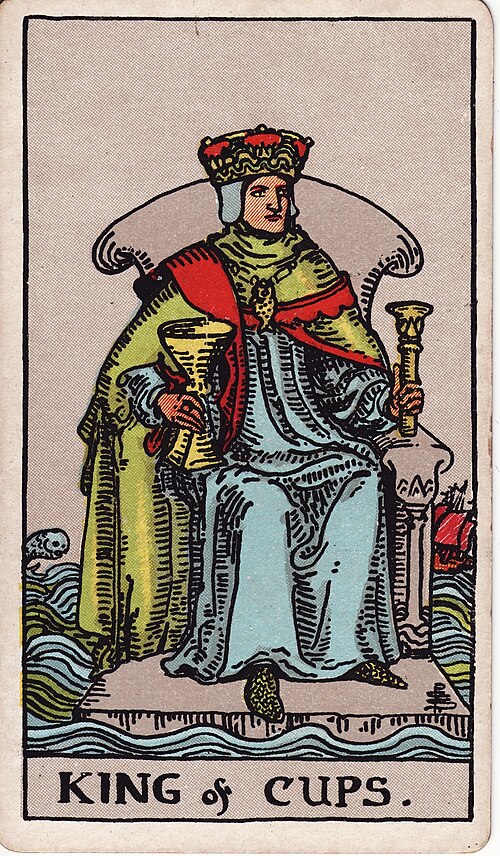
King of Cups Tarot Card Meaning
The King of Cups is a Minor Arcana court card, the King rank of the Cups suit, and position 50 in this 78-card RWS sequence. He follows the Queen of Cups and completes the Cups suit before the Ace of Swords. Cups traditionally organize emotion, relationship, imagination, receptivity, and inner life; the King presents these themes as mature regulation, ethical responsibility, and calm participation. He is not a promise that events will go smoothly, and tarot is used here as a symbolic and reflective practice rather than a scientifically validated predictive system.
RWS visual details: composure amid moving water
The RWS King sits on a stone throne in the middle of a sea. He wears a crown and holds an ornate cup in one hand and a scepter in the other. The cup appears covered or closed, while the scepter gives his posture a second, more active point of authority. The King faces mostly forward and remains upright, but the water around him is not still. Waves move near the throne, a small ship is visible in the distance to one side, and a fish appears on the other side of the card.
Blue water and blue clothing establish the Cups atmosphere, while yellow, red, and gold details add visibility and force. The stone seat and vertical figure create stability; the sea, ship, and fish introduce motion, livelihood, and the unpredictable life of feeling. The visual contrast is central: the King does not eliminate the water or climb out of it. He remains present while conditions shift. The closed vessel can suggest privacy and containment, but it should not be treated as proof of deception. These are image observations; ideas such as emotional mastery and diplomacy are traditional interpretations and editorial synthesis.
The Pictorial Key to the Tarot, credited in its public-domain archive edition to Arthur Edward Waite with illustrations by Pamela Colman Smith and dated 1911, provides a historical RWS-era layer for court-card meanings. Its short divinatory descriptions should be read as historical source material, not as scientific evidence or a complete modern psychology of the card. This article develops an original, image-led interpretation and marks practical applications as reflective methods.
Keywords explained from image and tradition
- Emotional steadiness — the upright figure remains composed while the sea moves around him.
- Mature care — the cup is held with attention, while the throne suggests responsibility for a wider setting.
- Diplomacy — water, ship, and fish place private feeling in a social and changing environment.
- Containment — the covered cup suggests that disclosure can be chosen rather than forced.
- Compassion with boundaries — the King can remain receptive without handing every impulse the controls.
- Ethical influence — the scepter adds the question of how authority is used.
- Shadow keywords: suppression, control, emotional performance, indulgence, or polished avoidance when composure becomes concealment.
Upright King of Cups meanings
Upright, the King of Cups describes the ability to feel fully while choosing a measured response. His core dynamic is not emotional absence but integration: the sea remains active, yet the King does not let every wave dictate his conduct. His strengths include patience, tact, emotional resilience, mediation, and the capacity to hold a difficult conversation without escalating it. He can represent a caring mentor, a trustworthy colleague, or an inner practice of responding rather than reacting.
The risk of excess is composure used as a mask. A person may sound calm while withholding relevant information, managing everyone else's feelings, or using kindness to avoid accountability. The King can also overindulge in comfort or become so invested in appearing balanced that genuine vulnerability is postponed. A practical upright action is to acknowledge the feeling, name the value or boundary at stake, and communicate a proportionate response. Calm should make truth safer, not make it disappear.
- Core dynamic: regulate emotion so it can inform responsible action.
- Potential strength: mediate, mentor, negotiate, or support others without losing perspective.
- Risk of excess: suppress anger, perform benevolence, control the emotional tone, or confuse calm with resolution.
- Practical action: pause before responding, state what is true, identify your responsibility, and leave room for another person's agency.
Reversed King of Cups meanings
A reversed King is not automatically cruel, weak, or doomed. Reversal can show a quality turned inward, blocked, delayed, exaggerated, or needing a different direction. The sea may be running the situation, or the figure may be keeping the lid on too tightly. Surrounding cards and the position determine whether the constructive response is expression, restraint, repair, or distance.
- Blockage: emotion cannot be translated into honest communication, so the situation becomes vague, passive, or hard to negotiate.
- Internalization: the person carries distress privately and may need safe support, rest, or a deliberate way to speak.
- Excess: emotional control becomes manipulation, silent punishment, savior behavior, dependency, intoxication, or polished denial.
- Delay: a conversation or decision is postponed while someone waits to feel completely composed or tries to manage every reaction first.
- Direction adjustment: replace image management with transparent limits
- say what you know, what you feel, and what remains uncertain.
- Constructive reversal: stepping back from a mediator role, seeking supervision, or admitting vulnerability can restore authentic steadiness.
Applications in ordinary life
- Relationships and emotions: Upright, the King supports mature affection, repair, and emotional safety without possessiveness. Reversed, examine emotional withholding, control disguised as care, or a relationship in which one person must regulate both people. The card cannot establish a partner's hidden feelings
- use direct conversation and observable behavior.
- Work and study: Upright, lead meetings, feedback, or conflict with patience and clear standards. In study, balance intuition with a method and deadlines. Reversed, watch office politics, vague promises, burnout hidden behind competence, or a mentor who demands emotional loyalty. Put agreements in writing.
- Money and resources: Upright, keep a cool head around shared resources and make decisions that respect both values and evidence. Reversed, beware of financial choices made to rescue someone, preserve an image, or avoid an uncomfortable conversation. Do not treat the card as investment-return advice
- review documents and consult a qualified professional.
- Personal growth: Practice emotional regulation without emotional suppression. Notice the difference between a calm nervous system, a postponed reaction, and a socially acceptable mask. Use journaling, conversation, creative work, or professional support as appropriate.
King of Cups in spreads and positions
The King changes emphasis according to the question and position. He can be a person, a skill, a social role, a resource, or a warning about emotional authority. Start with the image's tension between stable posture and moving water, then ask how that tension operates in the spread.
- One-card prompt: What feeling needs to inform my decision, and how can I express it without surrendering responsibility? The answer should lead to a specific conversation, boundary, or pause.
- Three-card past, present, future: In the past, he may show a learned model of care or a prior need for composure
- in the present, emotional regulation is the active task
- in the future, he may suggest a steadier response if practice continues. Do not turn the future position into a guarantee.
- Three-card situation, action, outcome: As situation, he describes the emotional climate and the level of maturity available. As action, he favors measured communication and principled limits. As outcome, he suggests a response that can hold complexity, not necessarily a conflict-free result.
- Relationship — self, other person, interaction: In self, examine how you manage feeling and power. In the other-person position, read a relational style or role rather than claiming access to private thoughts. In interaction, ask whether one person is containing the relationship for both, and whether that arrangement is chosen.
- Decision — opportunity, risk, advice: The opportunity is diplomacy, stewardship, or a wise pause
- the risk is suppression, control, or rescuing
- the advice is to combine emotional truth with explicit terms and evidence.
- Obstacle, advice, outcome: As obstacle, he can show a hidden feeling, a power imbalance, or a demand to look composed. As advice, respond calmly but do not erase the issue. As outcome, he points to greater capacity for repair, negotiation, or self-command.
Instructional combination reading
Instructional example, not a real case: read the Queen of Cups beside the King of Cups. The Queen emphasizes receiving and examining feeling; the King emphasizes regulating and expressing it responsibly. Together they can describe mutual emotional care, or a risk of overmanaging a relationship if both cards are surrounded by control themes. When the King is followed by the Ace of Swords, emotional steadiness is modified by a need for clear language, facts, or a decisive boundary.
Common misreadings, traditions, and responsible use
The King of Cups is often flattened into “a wise man” or “the perfect partner.” That treats a court card as a demographic label and ignores its shadow. Court cards can describe roles, behaviors, stages, or ways of engaging; they are not reliable labels for gender, age, orientation, or another person's character. Calm is not proof of wisdom, and a closed cup is not proof of dishonesty. Schools differ on elemental and astrological correspondences, the treatment of court cards, and whether reversals are used. Marseille and other traditions also use different imagery and conventions. In this RWS series, Strength is VIII and Justice is XI; Marseille commonly places Justice at VIII and Strength at XI. The sequence and primary image analysis here follow RWS.
Keep the reading responsible. Tarot can support cultural learning, symbolic thinking, journaling, and a conversation about choices. It cannot read a third party's mind, diagnose health conditions, decide legal matters, guarantee financial returns, or establish fate. For serious health, safety, legal, financial, or relationship decisions, rely on qualified professionals, consent, direct evidence, and your own informed judgment. Let the card sharpen a question and a next step, not replace reality testing.
Tarot journal prompts
- Where am I genuinely regulating emotion, and where am I only performing calm?
- What responsibility is mine in this situation, and what belongs to another person?
- What truth could I state clearly while still leaving room for uncertainty and dialogue?
Suggested learning links
- Previous card: Queen of Cups — tarot-card-queen-of-cups.
- Next card: Ace of Swords — tarot-card-ace-of-swords.
- Foundational reading: Tarot for Beginners — tarot-for-beginners
- Cups Suit Guide — tarot-cups
- Upright and Reversed Tarot — tarot-upright-and-reversed
- Three-Card Tarot Spreads — three-card-tarot-spreads
- Tarot Journal Review — tarot-journal-review.