Card identity and sequence
Justice is Major Arcana XI, the twelfth card in this 78-card Rider-Waite-Smith sequence. It belongs to the Major Arcana and concentrates on fairness, accountability, discernment, consequences, and decisions made with incomplete but relevant information. The name does not promise that every result will feel pleasant or that a cosmic court will intervene. It asks what is proportionate, what can be verified, and what responsibility follows from a choice.
This series uses RWS for sequence and primary image analysis. Waite’s Pictorial Key to the Tarot provides one public-domain historical layer of RWS commentary, while current readers may use Justice as a reflective framework for evidence and repair. Neither historical symbolism nor a modern tarot reading is scientifically validated prediction.
What is visible in the RWS image
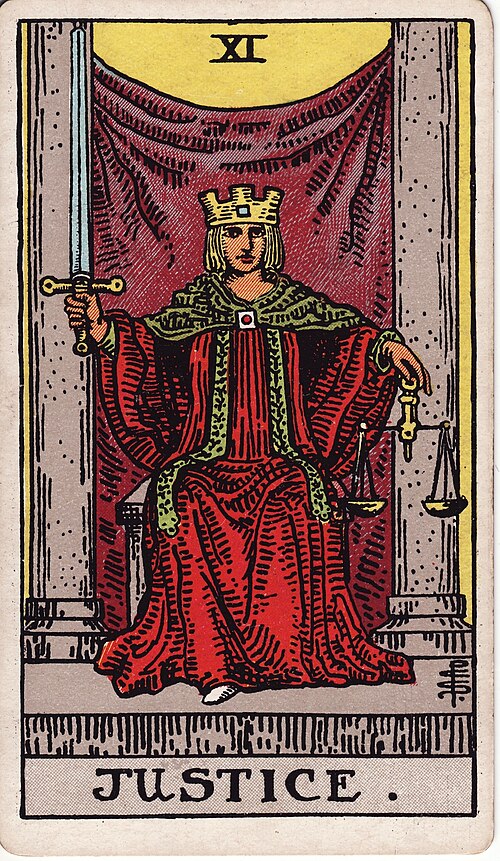
A crowned figure sits facing forward between two upright pillars. The figure wears a red robe, holds a double-edged sword vertically in the right hand, and balances a set of scales in the left. A yellow or gold crown and the strong red garment stand out against the more restrained architectural background. The frontal pose makes the encounter direct: the card looks back at the reader rather than showing a figure walking toward a distant scene.
The sword is held upright, giving the composition a central vertical line and a visible association with clear separation, decision, and speech. The scales are held level rather than dramatically tilted, so balance is shown as an active task. The pillars and throne establish a formal setting, while the curtain behind the figure frames rather than replaces the plain act of weighing. Details vary across reproductions and derivative decks; descriptions here stay with the visible RWS structure and do not treat every later occult correspondence as original to the card.
Keywords derived from the image and tradition
- Accountability — the seated judge-like figure faces the consequences of a decision
- balance — the level scales make proportion visible
- discernment — the upright sword separates relevant from irrelevant claims
- clarity — the frontal composition resists avoidance
- reciprocity — scales invite attention to both sides
- repair — a fair decision can include a proportionate corrective action.
These keywords arise from the image’s tools, posture, and setting, as well as the traditional association of Justice with judgment and equilibrium. They are interpretive prompts, not fixed verdicts. A reading should ask what evidence the question actually contains and what the specific position requires before choosing a meaning.
Upright meanings
Upright, Justice can indicate a decision that benefits from clear standards, honest evidence, and proportionate consequences. Its strengths include impartial review, keeping agreements, naming responsibility, correcting an imbalance, and making a choice that remains defensible after emotion settles. It may describe a contract, evaluation, boundary, conversation, or review process, but the card alone cannot establish the legal or factual outcome of a real dispute.
The risk of excess is cold judgment. A reader may confuse fairness with punishment, demand perfect certainty before acting, or reduce a complex person to one mistake. Practical action is to define the question, gather relevant information, identify competing interests, and state what would count as a fair process. Include your own role in the balance; Justice is not merely a tool for judging someone else.
Reversed meanings
Reversed, Justice may show blockage around accountability: facts are obscured, standards are applied unevenly, or a decision is being postponed because its consequences are uncomfortable. The theme may be internalized when self-criticism, guilt, or fear of being judged overwhelms a useful review. Excess can look like rigid perfectionism, scorekeeping, retaliation, or selective evidence.
Delay is possible when a process lacks information, a promise has not been clarified, or a person keeps avoiding a necessary conversation. Reversed does not automatically mean injustice, guilt, or defeat. It can redirect attention from issuing a verdict to repairing the method: check assumptions, ask whose voice is missing, correct an error, or renegotiate a standard. Upright does not guarantee a favorable result; it describes an approach to judgment, not a promise of victory.
Applications by life area
Relationships and emotions: Justice supports honest agreements, reciprocal effort, and conversations that distinguish impact from intention. In an emotional question, it may ask whether your boundaries match your values and whether both people are being held to comparable standards. It cannot reveal what a third party secretly thinks. Reversed, notice blame loops, silent scorekeeping, or self-punishment; clarify expectations before demanding a final verdict.
Work and study: Upright, the card favors assessment criteria, citations, transparent feedback, and decisions that can be explained. It can encourage a student to check the rubric or a worker to document responsibilities. Reversed, investigate inconsistent grading, unclear scope, missing context, or a tendency to judge your performance by an impossible standard. Seek a defined process rather than relying on indignation alone.
Money and resources: Justice points to budgets, invoices, terms, taxes, shared costs, and proportional exchange. It is not legal, accounting, or investment advice and cannot guarantee a financial result. Read agreements carefully, keep records, ask qualified professionals when stakes are high, and correct small discrepancies before they grow. Reversed, delay a commitment until unclear terms or unequal obligations are visible.
Personal growth: The card invites a review of choices without turning review into shame. Compare your stated values with repeated actions, make amends where appropriate, and build a standard you can apply consistently. Reversed, soften a punitive inner voice while remaining honest about impact. Accountability and self-compassion can coexist.
Justice in spreads
One-card prompt: “What needs to be seen clearly, weighed fairly, or brought into alignment?” In a one-card reading, Justice is a cue to define the standard and the evidence before writing an answer. It is not a yes-or-no substitute for due process.
Three-card situation, action, outcome: In situation, Justice describes the governing standard, imbalance, agreement, or decision already shaping the matter. In action, it advises fact-checking, documenting, communicating terms, or making a proportionate correction. In outcome, it suggests a clarified result or a consequence that follows from the process, but not necessarily the outcome you prefer. In a past, present, future spread, it may show an earlier choice, a current evaluation, and a later accounting of effects.
Relationship positions: For self, Justice highlights your role, standards, boundaries, and willingness to hear impact. For the other person, keep the interpretation to observable commitments and behavior; do not use the card to read their mind or declare them guilty. For the interaction, it examines reciprocity, agreements, repair, and whether the relationship’s rules are explicit or assumed.
Decision positions: In opportunity, Justice can identify a fair process, a transparent agreement, or a choice aligned with stated values. In risk, it warns about missing information, unequal terms, legal exposure, or harsh self-judgment. In advice, use evidence, name the standard, and accept the responsibility attached to the choice. In obstacle, look for avoidance, bias, or an undefined criterion. In outcome, expect clarification or consequence rather than a guaranteed win.
Instructional combination example
Instructional example, not a real case: Justice beside The Wheel of Fortune changes a broad turning point into a question about how change is distributed and handled. The Wheel adds timing and shifting conditions; Justice asks for records, fair terms, and proportionate action. Together they might support reviewing a changing agreement before committing, not predicting that events will automatically balance themselves.
Common misreadings, traditions, and responsible use
A common misreading is “Justice means the querent will win” or “the other person is guilty.” The image shows tools for weighing and separating, not a completed case file. Another mistake is treating fairness as identical treatment in every context; proportion, relevant circumstances, and repair may matter. Some schools emphasize legal or ethical judgment, while others foreground inner balance, cause and effect, or practical decision-making. Decks can alter clothing, colors, pillars, sword angle, and symbolic references, so compare the actual image in hand with the tradition being used.
RWS and Marseille traditions differ in some imagery and in the numbering of Strength and Justice. In the RWS order used here, Strength is VIII and Justice is XI, making Justice the twelfth position in the full 78-card sequence. Many Marseille-style sequences place Justice at VIII and Strength at XI. Keep the school visible when comparing books or decks rather than treating the numbering difference as an error. Tarot is a cultural and symbolic self-reflection practice, not a scientifically validated predictive system. It must not replace medical, legal, financial, educational, or mental-health professionals, and it should not be used to make coercive decisions about another person.
Tarot journal prompts
- What facts, assumptions, and missing voices belong on each side of the scales?
- Which standard am I applying, and would I apply it consistently to myself and others?
- What proportionate repair or boundary is available now?
- How can I review this choice without turning accountability into shame?
Suggested learning links
For the previous card, read The Wheel of Fortune Tarot Card (tarot-card-wheel-of-fortune), which explores changing conditions before Justice asks how they should be handled. The next card is The Hanged Man (tarot-card-the-hanged-man), a useful contrast between formal judgment and deliberate suspension. For foundations, see Tarot for Beginners (tarot-for-beginners), How to Ask Tarot Questions (tarot-how-to-ask), Upright and Reversed Tarot (tarot-upright-and-reversed), Three-Card Tarot Spreads (three-card-tarot-spreads), Tarot Journal and Review (tarot-journal-review), and Responsible Mysticism (ethics-and-boundaries).