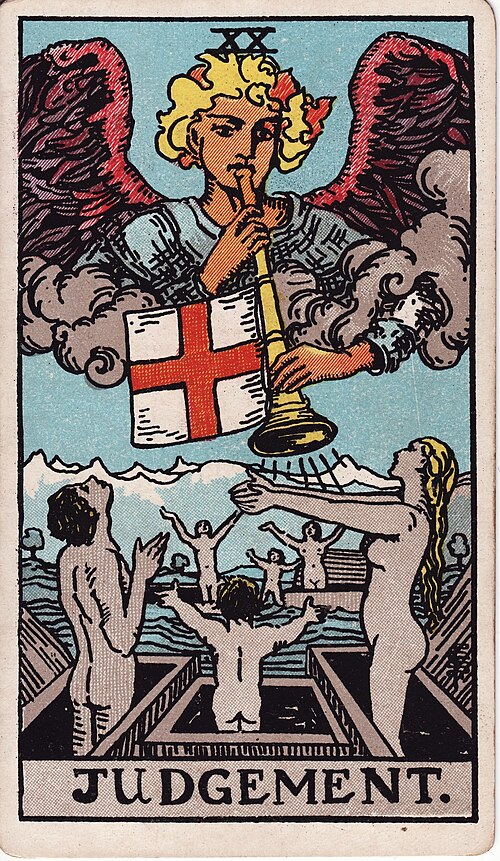
Card identity and place in the RWS sequence
Judgement is Major Arcana XX, the twenty-first card in this 78-card RWS learning sequence, with The Fool numbered 0. It follows The Sun and precedes The World. As a Major Arcana card, it usually frames a high-concentration theme such as evaluation, renewal, accountability, or a threshold rather than a small isolated event. The card is an invitation to examine what has happened, hear a meaningful call, and decide what deserves to be carried forward.
This series uses the Rider-Waite-Smith numbering and primary image analysis. RWS and Marseille traditions differ in the numbering of Strength and Justice, and their imagery and interpretive histories are not identical. That difference does not change Judgement's RWS number XX, but it is useful context when comparing decks.
What is visibly shown in the RWS image
A winged angel appears above a bank of clouds and blows a trumpet downward. A white banner marked with a red cross hangs from the trumpet. Below, pale human figures rise from rectangular gray coffins with their arms lifted toward the sound. Blue water lies behind them, with low land and distant mountains at the horizon. The figures are shown without clothing, so the image emphasizes a common human condition rather than a named social role. The angel's vertical position and the upward gestures create a clear line between announcement and response.
The image has a strong upward direction: sound descends, people rise, and attention turns toward a higher source. The cool grays and blues of clouds, water, and coffins are interrupted by the red cross, which gives the banner a concentrated visual focus. The scene does not show a courtroom or a written verdict. Its observable action is awakening to a summons. In Waite's Pictorial Key to the Tarot, credited to Arthur Edward Waite and illustrated by Pamela Colman Smith, Judgement belongs to a symbolic vocabulary of resurrection and final assessment; those traditional associations should be distinguished from what a modern reader may use the image to reflect on.
Keywords and how the image supports them
A concise keyword set is awakening, reckoning, release, calling, renewal, and accountability. Awakening follows the figures' movement out of closed coffins. Reckoning follows the implied review of a completed phase, not a prediction of punishment. Release comes from leaving the enclosed boxes and responding to a larger perspective. Calling follows the trumpet and the angel's announcement. Renewal follows the change from stillness to movement. Accountability follows the need to answer honestly, while remaining different from a fixed cosmic judgement. These keywords are interpretive tools drawn from the image and Major Arcana tradition, not an unexplained list of guaranteed outcomes.
Upright Judgement meanings
Upright Judgement often describes a moment when evidence, memory, or consequence becomes difficult to ignore. Its strength is honest review: naming what worked, acknowledging harm or learning, and recognizing a direction that fits the person you are now. It can support reconciliation when repair is real, a career or study decision after careful assessment, or a renewed commitment after a period of uncertainty. The card does not promise that an external authority will reward you; it asks what response your own understanding now requires.
The risk of excess is turning reflection into self-prosecution, demanding a perfect confession, or treating one past mistake as a permanent identity. Another excess is mistaking a dramatic feeling for a clear call without checking facts. Practical upright action is to gather records, invite proportionate feedback, separate responsibility from shame, and set a specific next step. If a decision affects other people, include consent, repair, and realistic consequences rather than using the card to pressure them.
- Upright strengths: clarity after review, forgiveness with accountability, readiness to answer a call, and the ability to close an old loop.
- Upright risks: moral grandstanding, compulsive self-judgment, public approval seeking, or rushing because a moment feels significant.
- Practical action: write the facts, identify the lesson, name the repair or boundary required, and choose one observable action with a review date.
Reversed Judgement meanings
Reversed Judgement does not automatically mean failure or punishment. It may show blockage when a person avoids an honest review, internalization when the call is felt privately but not yet expressed, excess when guilt or criticism becomes overwhelming, delay when a decision is postponed until certainty is impossible, or direction adjustment when an old definition of success no longer fits. The same reversal can describe a useful pause: more evidence, a safer setting, or a less theatrical way to respond may be needed.
To work with the reversal, ask what is actually unknown and what is merely uncomfortable. If the issue is blockage, make the review smaller and factual. If it is internalization, tell a trusted person or record the insight privately before acting. If it is excess, replace shame with proportionate responsibility. If it is delay, set a deadline for the next information-gathering step. If it is direction adjustment, revise the goal instead of forcing an outdated promise. Reversed Judgement can therefore redirect attention without declaring a negative fate.
Relationships, emotions, work, money, and personal growth
- Relationships and emotions: Upright, Judgement can emphasize an honest conversation, meaningful repair, or deciding whether a relationship can meet present values. Reversed, it may point to unspoken resentment, shame, repeated review of the past, or a need to stop interpreting silence as a verdict. It cannot establish what another person secretly thinks.
- Work and study: Upright, it favors feedback, exams, applications, portfolio review, graduation, and a deliberate change of direction. Reversed, it may show fear of evaluation, feedback absorbed as identity, an overdue revision, or a decision delayed while standards keep moving.
- Money and resources: Upright, review contracts, spending history, debts, and priorities before making a clean resource decision. Reversed, check for avoidance, guilt-driven spending, overcorrection, or waiting for a dramatic rescue. The card is not a promise of profit and is not investment advice.
- Personal growth: Upright, integrate experience into a more deliberate identity. Reversed, examine whether self-forgiveness is being confused with denial, or responsibility with lifelong punishment. A qualified professional may be more appropriate than tarot for serious mental health or trauma concerns.
Judgement in different spread positions
- One-card prompt: What truth or feedback is asking for a responsible response now? The emphasis is on a review and a next step, not on predicting an unavoidable event.
- Three cards, past, present, future: In the past, Judgement can show a prior assessment or unfinished consequence
- in the present, a call to decide or repair
- in the future, a possible integration point. In a situation, action, outcome spread, it describes the condition to assess, the response that accepts responsibility, or the result of a conscious review.
- Relationship positions, self, other person, interaction: In self, Judgement asks how your history shapes the present response. In the other-person position, it describes the role of evaluation or renewal in the situation, not that person's private mind. In interaction, it highlights a shared conversation, a repair process, or a turning point that requires both parties' agency.
- Decision positions, opportunity, risk, advice: As opportunity, Judgement favors learning from evidence and answering a fitting call. As risk, it warns against shame, public approval, or premature finality. As advice, it recommends a fair review, explicit standards, and a dated next action.
- Obstacle, advice, outcome: As obstacle, avoidance or harsh self-verdict may block movement. As advice, distinguish facts, responsibility, and forgiveness. As outcome, the card suggests a clearer relationship with the past, while the real-world result still depends on choices and conditions.
Instructional combination-reading example
Instructional example, not a real case: Judgement beside The Sun can shift a broad call to renew into a more visible, confidence-building review; the Sun adds openness but does not erase accountability. Judgement beside The World can emphasize completion after the review. Read the neighboring card as a modifier of the question and position, not as a fixed sentence or guaranteed event.
Common misreadings, deck differences, and responsible use
A common misreading treats Judgement as literal death, divine punishment, or a guaranteed public announcement. The image supports awakening and response more directly than any one event. Some readers connect the card to resurrection, karma, astrology, or religious symbolism; those are school-specific layers and should be named as traditions rather than universal facts. Marseille decks may use different scene details, titles, and sequence conventions, while some modern decks replace the trumpet or figures. Compare the actual image before importing RWS assumptions.
Tarot is a cultural and symbolic-reading practice that can support self-reflection. It is not a scientifically validated predictive method. Do not use Judgement to diagnose, read a third party's mind, promise a legal or financial result, or replace medical, mental-health, legal, academic, or investment expertise. For high-stakes choices, use qualified advice, consent, records, and a clear decision process. A card can prompt a review; it cannot absolve responsibility or make a choice for you.
Tarot Journal Prompts
- What evidence am I ready to review, and what part am I avoiding because it feels uncomfortable?
- What is the difference between proportionate accountability and punishing myself?
- What small, observable action would answer the card's call without demanding certainty?
Suggested learning links
For sequence context, continue from the previous card, The Sun, at tarot-card-the-sun, and continue to the next card, The World, at tarot-card-the-world. For foundations, build on tarot-for-beginners, major-arcana-guide, tarot-upright-and-reversed, three-card-tarot-spreads, tarot-how-to-ask, tarot-journal-review, and ethics-and-boundaries. These links provide method and boundaries without replacing this card-specific reading.