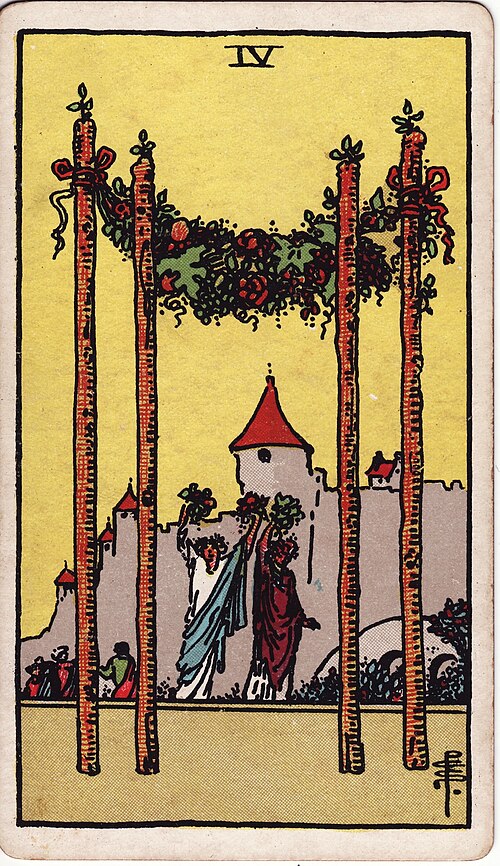
Four of Wands at a Glance
Card identity: Four of Wands. System: Rider-Waite-Smith (RWS). Suit and rank: Wands, Four. Group: Minor Arcana. Sequence position: 26 of 78, after the Three of Wands and before the Five of Wands. The Wands suit brings action, vitality, creativity, and intention; the number four adds a frame, pause, or practical structure in which that energy can be shared and sustained.
The Four of Wands often appears when a process reaches a meaningful threshold. It can point to a celebration, a supportive home or team, a ceremony, a reunion, or a moment of relief after work. Its message is not that every foundation is permanent or every gathering is safe. It asks what has been built, who is included, and how enjoyment can become a resource for the next stage rather than a reason to stop paying attention.
Visible RWS Image
The RWS image shows four upright wands arranged as a strong rectangular frame, with a garland stretched across the upper space. Two figures stand in the foreground, visibly raising bouquets or flowers in a celebratory gesture. Behind them are a bridge or open approach, green ground, and a castle or settled building. The sky is bright, and the palette combines warm yellow and orange with green landscape and red and blue details in the figures and architecture. The eye moves from the near ceremonial frame toward the welcoming settlement beyond it.
The image visibly supports structure, arrival, shared recognition, and a public or communal threshold. It does not prove a wedding, permanent property, universal happiness, or a particular event. Traditional readings develop the scene into harmony, completion of a stage, hospitality, and celebration. Modern reflective practice can also use it to ask whether the questioner feels at home in a place, group, relationship, or achievement, and whether the visible celebration matches the lived experience.
Keywords from Image and Tradition
A concise keyword set is: celebration, belonging, stability, milestone, community, welcome, and integration. Celebration follows from the raised bouquets and garland; belonging follows from the shared foreground and settled background; stability follows from four upright supports; milestone follows from the framed threshold; community and welcome follow from the figures and inhabited landscape; integration follows from bringing effort into a place where it can be enjoyed and recognized. These keywords describe possible dynamics, not automatic promises.
Upright Four of Wands Meaning
Upright, the Four of Wands describes a pause that confirms progress. The card may mark a completed phase, a supportive gathering, a homecoming, or an agreement that makes further work possible. Its strength is the ability to notice shared success and let connection reinforce the foundation. It can encourage gratitude, hospitality, public acknowledgment, and a deliberate transition from building to inhabiting what has been built.
- Potential strengths: reliable support
- shared joy
- a clear threshold between stages
- cooperation that feels welcoming
- and the emotional steadiness that comes from recognizing real progress.
- Risks of excess: performing happiness for an audience
- assuming a ceremony settles every unresolved issue
- excluding people who helped create the result
- or becoming so comfortable that necessary maintenance is ignored.
- Practical actions: mark a milestone in a proportionate way
- thank contributors specifically
- clarify the agreements that hold a home or team together
- make room for rest
- and decide what the next phase needs before the celebration fades.
Reversed Four of Wands Meaning
Reversed does not automatically mean that joy is false or that a relationship, home, or project must end. It can show a celebration turned private, a foundation under pressure, or a threshold that has not yet been crossed. Read the direction as information about access, timing, and integration rather than as a simple negative verdict.
- Blockage: a group cannot agree on what is being celebrated, a home does not feel secure, or unresolved logistics prevent a shared arrival. Name the missing condition before trying to decorate the outcome.
- Internalization: the milestone matters deeply but is being processed quietly, perhaps because public recognition feels unsafe or unnecessary. Private satisfaction can be valid
- isolation is worth examining if support is needed.
- Excess: social approval, hosting, ceremony, or the appearance of harmony is taking priority over honest needs. Reduce performance and ask what kind of belonging is actually sustainable.
- Delay: a move, reunion, launch, graduation, or team agreement is postponed by timing, resources, or permissions. Use the pause to confirm practical details rather than treating delay as proof that the goal is wrong.
- Direction adjustment: redefine the event, widen or narrow the guest list, repair the foundation, or choose a smaller way to acknowledge progress. The card may recommend creating belonging before seeking a public seal.
Applications by Life Area
- Relationships and emotions: The Four of Wands can support mutual ease, shared celebration, meeting communities, moving toward a common home, or recognizing a relationship milestone. It can also reveal pressure to look settled before both people feel heard. Ask what security means to each person
- do not treat the card as proof of marriage or as a report of a partner's private feelings.
- Work and study: Upright, it favors a successful handoff, a cooperative team, a graduation or presentation, and a useful pause after completing a stage. Reversed, review team culture, unclear credit, event logistics, and whether a polished launch is hiding unfinished work.
- Money and resources: The card can describe a stable base, a shared household budget, a modest reward, or spending to mark a milestone. It is not permission to assume financial security or make a purchase beyond your means. Check contracts, reserves, maintenance, and the cost of sustaining the celebration.
- Personal growth: Practice receiving support and recognizing progress without needing perfection. Build rituals that help you remember what worked, then carry the lesson into the next stage instead of turning a temporary arrival into a fixed identity.
The Four of Wands in Spreads and Positions
The same image changes with the question and position. In a spread, the Four of Wands can describe an external event, an inner sense of arrival, a social container, or the conditions needed for a sustainable pause. Let surrounding cards and the actual question decide which emphasis is strongest.
- One-card prompt: Where can I acknowledge real progress and strengthen the conditions that make it repeatable? The card may point to a supportive practice rather than a literal party.
- Three-card past, present, future: In the past, it can show a prior milestone, home, team, or community that shaped the situation
- in the present, it highlights belonging and the need to pause
- in the future, it suggests an opportunity to integrate or celebrate progress if the foundation is maintained. In a situation, action, outcome spread, it describes the current social or structural container, recommends marking and reinforcing it, and leaves the outcome dependent on participation and upkeep.
- Relationship spread - self, other person, interaction: In self, it shows how ready you are to share joy or define home. In the other person's position, it describes the role they bring to the shared space without claiming to know their thoughts. In interaction, it asks whether the relationship has mutual rituals, safety, and room for both people's communities.
- Decision spread - opportunity, risk, advice: As opportunity, it points to a supportive environment, a milestone, or a chance to join a healthy network. As risk, it warns of appearances, group pressure, or premature commitment. As advice, celebrate proportionately, confirm the foundation, and include the people affected by the decision.
- Obstacle, advice, outcome: As obstacle, belonging or logistics may be unsettled. As advice, establish a welcoming structure and make the agreement visible. As outcome, it can show recognition, a shared threshold, or a more settled base, but it does not guarantee permanence.
Combination Reading Example
Instructional example, not a real case: Three of Wands beside the Four of Wands can show an outward project arriving at a community or home base. The Three emphasizes reach, distance, and feedback; the Four asks how that growth will be hosted, shared, and sustained. If the Five of Wands follows, the celebration may need to include honest negotiation rather than assuming everyone agrees. Adjacent cards refine the conditions; they do not create a guaranteed event.
Common Misreadings, Schools, and Deck Differences
A common misreading is to call the Four of Wands only a wedding card or to read any garland as proof of permanent happiness. Another is to ignore the work required to maintain the structure because the foreground looks joyful. In RWS, the illustrated scene provides figures, architecture, landscape, and a threshold; a Marseille-style pip card may arrange four wands without the same narrative scene, so number, suit, and neighboring cards carry more of the interpretation. RWS and Marseille traditions also differ in the numbering of Strength and Justice and in some imagery. This series follows RWS, where Strength is VIII and Justice is XI, for sequence order and primary image analysis. A. E. Waite's Pictorial Key is a historical reference for traditional meanings; the life applications here are modern editorial synthesis rather than claims about one universal school.
Responsible Use
Tarot is presented here as a cultural, symbolic-reading, and self-reflection tool, not a scientifically validated forecasting system. Use the card to identify questions, agreements, and observable conditions. Do not use it to read a third party's mind, decide medical or legal matters, promise investment returns, pressure someone into a commitment, or declare guaranteed fate. For important choices, combine reflection with evidence, consent, qualified professional advice, and the freedom to revise your plan.
Tarot Journal Prompts
- What milestone is genuinely complete, and what maintenance will keep its foundation sound?
- Where do I feel welcomed, and where am I performing belonging for approval?
- Who should be thanked, consulted, or included before I call this outcome a shared success?
Suggested Learning Links
- Previous card: Three of Wands - /tarot-card-three-of-wands
- Next card: Five of Wands - /tarot-card-five-of-wands
- Foundations: Tarot for Beginners - /tarot-for-beginners
- Wands Suit Guide - /tarot-wands
- Upright and Reversed Reading - /tarot-upright-and-reversed
- Practice: How to Ask Tarot Questions - /tarot-how-to-ask
- Three-Card Tarot Spreads - /three-card-tarot-spreads
- Tarot Journal Review - /tarot-journal-review