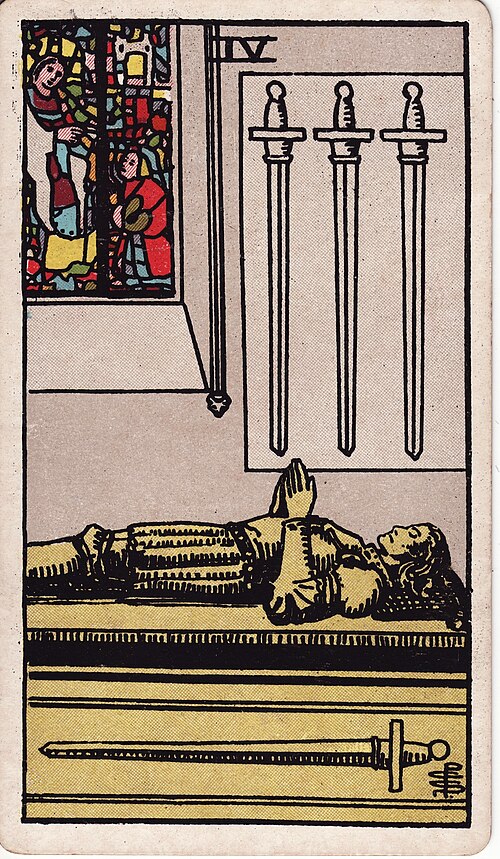
Four of Swords at a glance
The Four of Swords is Minor Arcana, Swords suit, rank Four, and position 54 in this 78-card RWS series. It follows the Three of Swords and precedes the Five of Swords. Its scene shifts from the Three's exposed emotional wound to a stone interior where a recumbent figure rests beneath three swords displayed on a wall, while a fourth sword lies beside the figure. The card can symbolize a deliberate pause, retreat, recovery, prayer, or the mental space needed before a next decision. It does not diagnose illness, guarantee recovery, or command someone to ignore urgent responsibilities. Treat it as a prompt to examine pace, boundaries, and the quality of rest available in the real situation.
What the RWS image shows
The card shows a carved or armored effigy lying horizontally on a stone structure, with hands held together in a prayer-like position. Three swords are arranged vertically on the wall above the figure, and a fourth sword is placed horizontally below or beside the resting body. The setting is architectural and quiet, with grey stone dominating the foreground; a stained-glass window and small architectural details add a devotional or memorial atmosphere. The figure faces upward and inward rather than toward an active landscape. The repeated vertical swords create order and containment, while the separate horizontal sword brings the suit's sharp mental tool into a resting position. These are visible features. Traditional interpretation supplies themes of solitude, retreat, and repose; the practical synthesis asks what kind of pause would actually restore judgment.
Keywords derived from image and tradition
- Rest and stillness — the body is horizontal and the scene has no visible action or movement.
- Retreat and boundaries — the stone setting and enclosed architecture create distance from ordinary demands.
- Mental reset — four swords are present, but none is being wielded, suggesting thought held in reserve.
- Prayer and contemplation — the joined hands and devotional details invite inward attention without requiring a religious belief.
- Preparation — the swords remain available, so the pause can be a staging point for a later, more considered response.
The keywords follow from the picture's posture, enclosure, and arrangement rather than from a fixed answer key. The number four often encourages readers to notice structure, stability, and a temporary container; the Swords suit adds thought, language, conflict, and discernment. Waite's older associations include vigil, retreat, solitude, a hermit's repose, exile, and a tomb. Those terms carry different emotional weights in different contexts, so a present-position Four of Swords may be a healthy boundary while an obstacle-position card may show withdrawal that has lasted too long. Let the card's quietness refine the question instead of turning it into a blanket instruction to stop.
Upright meaning
Upright, the Four of Swords describes a useful interval between mental strain and renewed engagement. Its core dynamic is suspension with purpose: step back, reduce input, protect attention, and allow a decision to mature. Its strengths include composure, recovery of perspective, disciplined silence, and the ability to avoid making a sharp situation sharper. Its risks of excess are isolation, passivity, avoidance, and confusing inactivity with healing. Practical actions might include setting a meeting-free block, sleeping on a non-urgent choice, limiting repetitive messages, organizing notes before replying, or asking a trusted person to help define the next step. Rest is not the same as surrender; the card is strongest when the pause has a clear review point and a humane boundary.
Reversed meaning
Reversed, the Four of Swords can reveal a blockage around rest itself. It may show internalization when every concern is kept private, excess withdrawal when solitude becomes disconnection, delay when preparation has become indefinite postponement, or restless overactivity that prevents the pause the situation requires. It can also mark a direction adjustment: return gradually, shorten the retreat, change the environment, or replace passive waiting with a small scheduled action. Reversed does not automatically mean negative. In a tense reading, it may indicate that a person is ready to leave an unproductive retreat; in another, it may warn that returning too quickly will repeat the same mental pattern. Ask what evidence would show that the pause has done its work.
Applications in everyday life
- Relationships and emotions — Upright can suggest space for cooling down, a respectful boundary, or quiet processing after conflict. It does not prove indifference. Reversed may show stonewalling, loneliness, emotional shutdown, or a gradual return to dialogue. Speak about your own needs rather than claiming to know another person's inner state.
- Work and study — The card supports a review day, deliberate planning, focused recovery after a demanding period, or a temporary reduction in interruptions. Its risk is using preparation as a permanent substitute for delivery. Reversed, identify the smallest task that restarts momentum and set a realistic deadline.
- Money and resources — Read it as a pause for account review, cooling-off time before a purchase, or conservative planning while facts are gathered. It cannot predict profits or replace financial, tax, or legal advice. Reversed may point to delayed paperwork, avoidance of a resource problem, or the need to revise a frozen plan.
- Personal growth — Explore the difference between solitude that restores and isolation that narrows perception. A short contemplative practice, journal entry, or quiet walk can make the distinction visible. Reversed, adjust the practice so it leads back to life rather than away from it.
The card in different spread positions
- One-card prompt — What needs a protected pause, and what would tell me that the pause is complete? This makes the card a practical pacing question rather than a prediction of inactivity.
- Three-card past, present, future — In the past, it may show a period of retreat or a mental burden that shaped the question
- in the present, a need to stop reacting and recover perspective
- in the future, a likely interval of consolidation before action. The future remains conditional on how the querent manages time and obligations.
- Three-card situation, action, outcome — As situation, it describes fatigue, distance, or a decision held in suspension. As action, it favors a defined pause, quiet review, and a boundary against noise. As outcome, it can indicate renewed clarity or a longer delay if no review point is set.
- Relationship positions: self, other person, interaction — In self, examine your need for space and whether you are communicating it. In the other-person position, read a possible role of distance or processing without mind-reading. In interaction, the card may describe a relationship needing a ceasefire, a quieter rhythm, or a conversation postponed until both sides can listen.
- Decision positions: opportunity, risk, advice — The opportunity is to create conditions for sound judgment
- the risk is hiding from a choice or letting silence create new confusion
- the advice is to pause proportionately, gather information, and name when you will reassess.
- Obstacle, advice, outcome — As obstacle, exhaustion, avoidance, or excessive privacy may block movement. As advice, build a restorative boundary with a specific duration and next check-in. As outcome, the card emphasizes stabilization and perspective, not a guaranteed success or permanent withdrawal.
Instructional combination example
Instructional example, not a real case: Three of Swords, Four of Swords, and Five of Swords appear together. The Three names an exposed hurt or difficult truth; the Four inserts a necessary pause so that the next response is not purely reactive; the Five warns that unresolved tension could become a contest, harsh exchange, or costly victory. The middle card therefore modifies both neighbors: it is not escape from the issue, but a chance to decide whether engagement can be honest and proportionate. If the Four is reversed, the same sequence may show a pause that has become avoidance, allowing conflict to sharpen in the background.
Common misreadings, traditions, and responsible use
A common misreading treats the Four of Swords as a literal prediction of illness, hospitalization, death, or guaranteed success after rest. The tomb-like architecture can evoke mortality and memorial imagery, but symbolic association is not a medical or factual diagnosis. Other readers flatten it into laziness; that misses the organized swords, prayerful posture, and deliberate containment. Marseille-style decks often present Minor Arcana pips without the RWS tomb scene, so their Four of Swords may begin with number, suit, balance, and pattern rather than a resting effigy. RWS and Marseille also differ in some imagery and in the numbering of Strength and Justice: this series uses RWS, where Strength is VIII and Justice is XI, while Marseille commonly places Strength at XI and Justice at VIII. Reversal practice varies by school; a reversal can indicate blockage, inwardness, excess, delay, or redirection, not automatic bad luck. Tarot here is cultural study, symbolic reading, and self-reflection, not scientifically validated predictive power. Do not substitute it for medical, legal, financial, or safety guidance, and do not use it to claim private knowledge about another person.
Tarot journal prompts
- What kind of rest would restore my judgment rather than merely postpone a decision?
- Which boundary would make quiet time respectful and clear to the people affected?
- What observable sign will tell me that I am ready to re-enter the situation?
- Where am I calling avoidance recovery, or calling necessary recovery avoidance?
Suggested learning links
For sequence context, read Three of Swords at tarot-card-three-of-swords, then continue to Five of Swords at tarot-card-five-of-swords when it is available. For foundations, pair this article with Tarot for Beginners at tarot-for-beginners, Tarot Upright and Reversed at tarot-upright-and-reversed, Three-Card Tarot Spreads at three-card-tarot-spreads, Tarot Journal Review at tarot-journal-review, and the Swords suit guide at tarot-swords. These links provide general method and reflection practice; this entry focuses on the Four of Swords as an individual card and does not treat the general court-cards guide as one.