Four of Pentacles at a Glance
The Four of Pentacles is Minor Arcana, Pentacles suit, rank four, and position 68 in this RWS series of 78 cards. Its central question is how a person holds, protects, limits, or shares a tangible resource. The card can describe prudent consolidation and clear boundaries, but also fear-driven control and difficulty allowing movement. It offers a symbolic framework for reflection, not a promise of wealth, loss, or future security.
This series uses the Rider-Waite-Smith order. RWS places Strength at VIII and Justice at XI, while many Marseille traditions place those numbers in the opposite order and use different imagery. Minor Arcana scenes also vary across decks. The reading here gives priority to the visible RWS composition and distinguishes traditional associations from modern practical application.
RWS Image: Holding the Center
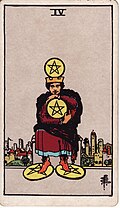
A crowned figure sits on a low stone seat in the foreground, facing outward toward the viewer. One pentacle is held tightly against the chest by both arms. A second coin rests on top of the crown or head, while two more are fixed beneath the feet. The figure's knees and feet create a compact, planted shape, and the body appears guarded rather than open-handed.
Behind the figure is a distant city with towers, set beneath a broad blue-gray sky. The red clothing and yellow crown stand out against the cooler stone and muted background. The four coins are not circulating between people: they are attached to head, chest, and feet. That arrangement visibly links money or material concerns with thought, feeling, and movement. The card does not show a literal vault, theft, or specific economic class; those are interpretive extensions, not visible facts.
A historical note keeps the article precise. A. E. Waite's The Pictorial Key to the Tarot, published in 1911 and illustrated by Pamela Colman Smith, is an important source for the RWS tradition. It should not be treated as a universal dictionary for every deck. The image supports an editorial synthesis about holding and circulation; readers may apply that synthesis to time, attention, money, possessions, or boundaries according to the question.
Keywords and Why They Fit
- Security and conservation: three coins are physically secured by the body and one is held close. Possession: the figure's grip and posture emphasize keeping a resource under personal control. Boundaries: the compact stance protects access to the coins and to the self. Stability: the seated, grounded figure has created a firm base. Control and rigidity: nothing is being exchanged, and the same protective arrangement can restrict movement. Scarcity fear: the image can symbolize the belief that release will leave too little, although that belief must be tested against context.
These keywords arise from the card's posture, coin placement, crown, city, and lack of open exchange. They are not automatic moral judgments. Holding a resource can be wise when it protects a necessary reserve; it becomes problematic when protection prevents circulation, learning, generosity, or adaptation.
Upright Four of Pentacles Meaning
Upright, the Four of Pentacles often describes consolidation. Make a budget, preserve a reserve, protect your time, clarify ownership, or establish a boundary before taking on more. Its strength is containment: the card recognizes that a stable base can be necessary after uncertainty. It may also indicate a careful custodian, a realistic limit, or a deliberate decision not to spend energy where the return or consent is unclear.
Its risk of excess is contraction. Holding too tightly can become hoarding, possessiveness, micromanagement, defensiveness, or an identity built around what one owns. The card may protect the present while quietly starving the future. A practical action is to define what must be protected, what can move, and what evidence would justify changing the rule. Security is stronger when it is designed rather than driven only by fear.
Reversed Four of Pentacles Meaning
Reversed, this card does not automatically mean reckless loss or generosity. It can show a grip loosening, a private fear becoming visible, or an internal struggle over control. Sometimes it advises release; sometimes it warns that a boundary, reserve, or ownership agreement is too weak. Read the direction of adjustment from the question and surrounding cards.
- Blockage: fear of loss, possessiveness, or a rigid rule prevents necessary sharing, spending, delegation, or emotional openness. Internalization: anxiety about safety stays inside, so the person appears calm while privately counting every risk. Excess: over-release, impulsive spending, compulsive caretaking, or trying to control every variable creates instability. Delay: a purchase, payment, decision, conversation, or transition waits because no level of certainty feels sufficient. Direction adjustment: release what is no longer useful, rebuild a realistic reserve, renegotiate access, or replace fear-based control with a clear boundary.
A reversed Four of Pentacles can therefore be a constructive correction. It may invite a small, measured act of circulation rather than total surrender, or a practical safeguard rather than another layer of anxiety. Ask whether the card is showing too much holding, too little holding, or a transition between the two.
Applications in Life Areas
Relationships and emotions: upright, the Four of Pentacles can describe loyalty expressed through steadiness, a need for privacy, or a wish to protect emotional energy. It can also show possessiveness, guarded affection, or difficulty receiving change. Reversed, explore whether someone is releasing an old defense or feeling unsafe because boundaries are unclear. The card cannot reveal another person's thoughts or guarantee commitment; use conversation and consent to learn what is actually happening.
Work and study: upright, create a reliable workflow, protect focused time, retain important knowledge, and avoid taking on commitments that exceed capacity. It can be useful for building a portfolio or maintaining standards. Reversed, check for hoarded information, fear of delegation, burnout from refusing help, or a need to revise a role. A small handoff with clear documentation can test whether control is necessary.
Money and resources: this is a strong prompt for reviewing reserves, recurring costs, ownership, debt obligations, and spending limits, but it is not investment or financial advice. Upright can favor conservation; excess can become paralysis or scarcity thinking. Reversed may point to a needed release, a poorly protected resource, or a budget that must be rebuilt. Use current records and qualified professional advice for consequential choices.
Personal growth: upright, notice where a boundary supports your values and where an attachment narrows your life. Reversed, practise flexible security: keep a sensible reserve while allowing learning, connection, or renewal to occur. Journaling can separate a present fact from an inherited fear about not having enough.
The Four of Pentacles in Spreads
Position matters. The Four of Pentacles may name a useful limit in one place and a costly fixation in another, so do not treat it as a universal yes, no, wealth, or loss card.
- One-card prompt: What am I protecting, and what would a measured release or stronger boundary look like today? Three-card situation, action, outcome: in Situation, identify the resource, fear, or limit being held
- in Action, set a concrete budget, boundary, conversation, or experiment
- in Outcome, observe whether stability increases or circulation becomes possible, without treating the card as a fixed forecast. Relationship self, other person, interaction: for Self, examine your openness and boundaries
- for Other Person, read the role they may occupy in the pattern without claiming access to their mind
- for Interaction, study trust, reciprocity, access, and control. Decision opportunity, risk, advice: Opportunity may be consolidation, privacy, or a chance to preserve capacity
- Risk may be rigidity, possessiveness, or refusing a useful change
- Advice is to name the minimum safety needed and the cost of holding beyond it. Obstacle, advice, outcome: as Obstacle, locate the fear or ownership rule
- as Advice, protect essentials while choosing one flexible step
- as Outcome, assess what is secured, released, or still immobilized rather than predicting a guaranteed financial result.
Instructional Combination Reading
Instructional example, not a real case: Three of Pentacles followed by Four of Pentacles can show a skilled project moving from collaboration into consolidation. The Four may mean protecting a sound result, but it can also show one contributor withholding knowledge or credit. If Five of Pentacles follows, the sequence may highlight how excessive holding can intensify isolation or fear; if another supportive card follows, the same Four may function as a healthy reserve. Adjacent images modify the card instead of replacing its core question about how resources are held.
Common Misreadings, Deck Differences, and Boundaries
The most common misreading is "wealth" as a guaranteed outcome. Four coins can signify resources, but the image is equally concerned with the body's defensive relationship to them. Another error is treating every boundary as selfish or every release as virtuous. RWS readers may stress control and fear of loss; other schools may emphasize material stability, conservation, or the number four as structure. Marseille pip cards and modern decks may not show the crowned figure, so use their actual arrangement rather than importing RWS details.
Use tarot as cultural study, symbolic interpretation, and self-reflection. Do not present this card as scientifically validated prediction or as a basis for medical, legal, or investment-return decisions. Do not use it to pressure someone into giving money, disclose private information, or claim that a relationship or loss is fated. For real financial or safety concerns, rely on records, consent, qualified advice, and practical planning.
Tarot Journal Prompts
- What resource, boundary, or piece of information am I protecting? Which part of my caution is supported by present evidence, and which part is inherited fear? What small act of circulation would be safe and reversible? Where would clearer ownership or a simpler rule create more security?
Suggested Learning Links
Read backward to the independent Three of Pentacles article at tarot-card-three-of-pentacles and forward to Five of Pentacles at tarot-card-five-of-pentacles. For foundations, use the site's Tarot for Beginners article at tarot-for-beginners, the Pentacles suit guide at tarot-pentacles, the upright and reversed method at tarot-upright-and-reversed, the three-card spread guide at three-card-tarot-spreads, and the Tarot journal review at tarot-journal-review. These resources add method and context without replacing this card-specific reading.