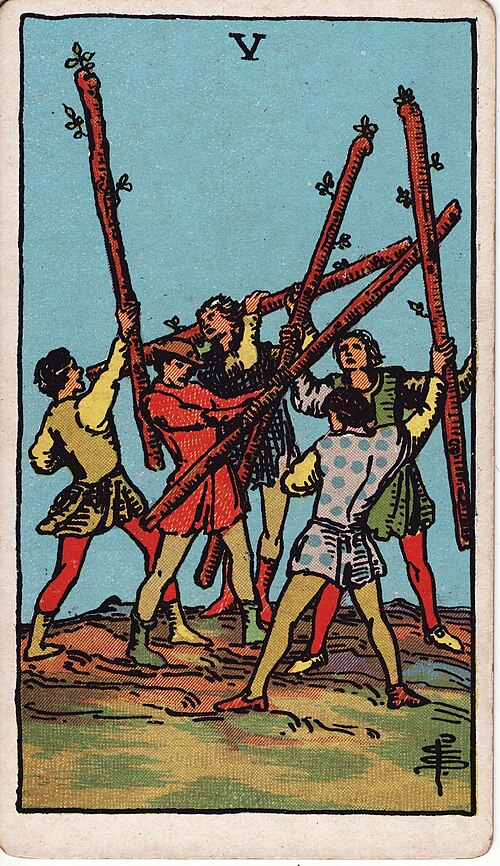
Five of Wands at a glance
The Five of Wands is a Minor Arcana card in the Wands suit, rank Five, and sequence position 27 in this Rider-Waite-Smith (RWS) series. It follows the Four of Wands and comes before the Six of Wands. Its central dynamic is active friction: several people, aims, or methods occupy the same field, and energy is being tested through contest. The card can describe creative debate, rivalry, practice, or needless conflict. It does not by itself prove hostility, defeat, or a destined fight. Read the image, the question, the card position, and the surrounding cards together.
RWS visual language
Five young figures stand outdoors with long wooden wands raised and crossing at different angles. Their bodies turn in different directions, and no figure is presented as an unmistakable winner or leader. Their contrasting clothing includes red, blue, green, and yellow tones against a pale blue sky and a simple green, uneven landscape. The staffs are the dominant lines in the picture: they interrupt one another, create visual pressure, and make coordinated movement difficult to see. The scene has no throne, building, trophy, or visible wound. These observable details support a reading of competing impulses and a problem that may be managed through coordination rather than treated as a battle to the death. Traditional meanings can extend that visual tension into struggle, rivalry, and testing; the practical synthesis here asks what kind of contest is actually occurring.
Keywords and how they follow from the card
The concise keyword set is competition, friction, practice, scattered effort, and negotiation. Competition follows from multiple figures wielding similar tools in one shared space. Friction follows from the crossing staffs and opposed directions. Practice is a useful constructive reading because the figures appear engaged but not visibly injured or defeated. Scattered effort describes energy that has not yet become one plan. Negotiation follows when the same field must accommodate several people. These are prompts for interpretation, not a fixed word list or a prediction.
- Competition and rivalry
- creative or verbal friction
- testing skills
- too many agendas
- coordination before escalation.
Upright meaning
Upright, the Five of Wands often describes a live situation in which energy is available but alignment is incomplete. Its strengths are courage to participate, willingness to test an idea, resilience under challenge, and the stimulation that comes from hearing alternatives. In work or creative study, disagreement can reveal weak assumptions and improve a draft. The risk of excess is turning every difference into a contest, speaking over others, mistaking volume for evidence, or spending effort on status rather than the goal. Practical action is to name the shared objective, separate useful critique from provocation, assign clear roles, and set a fair rule for deciding. If the question concerns conflict, check whether the disagreement is harmful, productive, or simply poorly structured; the card alone cannot decide that.
- Strengths: stamina, initiative, competitive learning, and honest testing. Risks: ego contests, fragmentation, escalation, and avoidable noise. Action: define the goal, hear each position, choose a process, and review the result.
Reversed meaning
Reversed does not automatically mean a bad result. It may show the Five of Wands turned inward or operating out of sequence. Blockage can appear as avoidance of necessary feedback, suppressed anger, or a group that cannot agree on rules. Internalization can mean comparing yourself with imagined rivals, rehearsing arguments privately, or feeling competitive without expressing the real need. Excess can show chronic debate, provocation, defensiveness, or conflict that consumes the work. Delay may arise when everyone keeps contesting the method instead of beginning. Direction adjustment is to reduce the arena: clarify one question, pause before responding, choose a smaller experiment, or move from winning to learning. In some readings the reversal simply marks conflict that is cooling or competition that no longer deserves attention.
- Blockage: feedback or participation is stuck. Internalization: rivalry becomes self-criticism. Excess: argument outgrows the purpose. Delay: process disputes prevent action. Adjustment: simplify the task and establish a calmer decision rule.
Relationships, emotions, work, resources, and growth
In relationships and emotions, upright may describe flirtatious sparring, differing needs, a busy social field, or a conversation that needs rules before it becomes constructive. Reversed may point to unspoken resentment, social comparison, passive-aggressive exchanges, or the relief of stepping away from a needless argument; it does not reveal another person’s private thoughts. In work and study, the card favors peer review, debate, rehearsal, and a competitive environment when standards are explicit. It warns against office politics and group projects with no ownership. For money and resources, read it as competing priorities, bids, expenses, or limited resources that need a transparent budget, not as a promise of profit or loss. For personal growth, ask how you respond when challenged: do you sharpen your skill, defend an identity, or abandon a useful goal? A small, observable action is safer than a dramatic conclusion.
Spreads and position changes
For a one-card prompt, ask, “Where is energy competing today, and what rule would make it useful?” The card then emphasizes a present pattern to observe, not a fixed event. In a three-card situation, action, outcome spread, Five of Wands in Situation identifies the active disagreement; in Action it recommends testing, speaking clearly, or setting boundaries; in Outcome it suggests continued activity whose value depends on whether the participants coordinate. In a past, present, future spread, it can show an earlier contest, current pressure, or a future need to distinguish healthy challenge from escalation. In relationship positions, Self may describe your conflict style, Other Person may describe the role that person occupies in the interaction rather than their hidden mind, and Interaction shows the shared pattern of mutual stimulation or mutual aggravation. In a decision spread, Opportunity can be a chance to learn through competition, Risk can be fragmentation or ego, and Advice can be to define criteria before entering the contest. In Obstacle, it names scattered agendas; in Advice, it favors a fair process; in Outcome, it shows what the current level of coordination produces. The position changes the emphasis; the card never supplies a guaranteed yes or no.
Instructional combination example
Instructional example, not a real case: Four of Wands beside the Five of Wands can contrast a welcoming structure with the friction that follows when many people use it. The Four supplies a shared base; the Five asks whether its roles and expectations are clear. Five of Wands beside Six of Wands can show a progression from testing and rivalry toward recognition, but only if skill and cooperation convert effort into a result. Adjacent cards modify the direction; they do not erase the Five’s need to examine conflict.
Misreadings, traditions, and responsible use
A common misreading is “five wands means a fight” or “this card guarantees defeat.” The RWS scene does not show a single loser, and later decks may change the figures, colors, or degree of menace. Marseille-style pip cards often offer less scene-based imagery, so readers may rely more on number, suit, and surrounding cards. RWS and Marseille traditions also differ in the numbering of Strength and Justice: RWS places Strength at VIII and Justice at XI, while Marseille commonly reverses those positions; imagery and interpretive systems vary as well. This series uses RWS numbering and image analysis. Tarot is a cultural and symbolic self-reflection practice, not scientifically validated prediction. Do not use this card to read a third party’s mind, make medical, legal, or investment-return decisions, or justify intimidation. For high-stakes choices, use evidence, consent, qualified advice, and your own agency.
Journal prompts and learning links
Journal prompts: What exactly is being contested, and what is the shared goal? Which part of the conflict is useful information? What boundary or decision rule would lower unnecessary heat? Suggested learning links are the previous card, Four of Wands, at tarot-card-four-of-wands; the next card, Six of Wands, at tarot-card-six-of-wands; and the foundational guides Tarot for Beginners at tarot-for-beginners, Tarot Wands at tarot-wands, Upright and Reversed Tarot at tarot-upright-and-reversed, How to Ask Tarot Questions at tarot-how-to-ask, and Three-Card Tarot Spreads at three-card-tarot-spreads. These links build context without replacing this card’s individual reading.