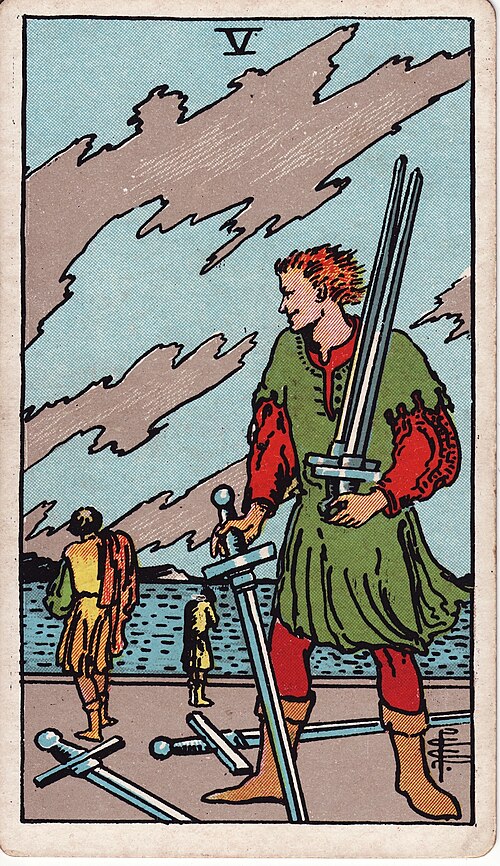
Five of Swords at a glance
The Five of Swords is a Minor Arcana card in the Swords suit, rank Five, and position 55 in the 78-card sequence. In the RWS order it follows the Four of Swords and precedes the Six of Swords. Swords often organize thought, speech, judgment, boundaries, and conflict; the number five disrupts the Four's pause with friction and a changed balance. This card is not proof of violence, betrayal, or a permanently bad person. It is a prompt to examine how a contest was handled and what remains afterward.
RWS visual details and source layers
The RWS scene shows a foreground figure on uneven ground holding three swords while turning his head toward two figures who recede in the distance. Two further swords lie on the ground. Behind them are water, a low horizon, and a gray, clouded sky. The foreground figure's raised position and collected blades create a visible contrast with the smaller departing figures and abandoned weapons. Muted blue-gray, yellow-brown, and red accents make the scene feel tense rather than festive. These are observable details; traditional meanings of defeat, dispute, and dishonor are interpretive layers built around the composition, not literal events guaranteed by it.
Arthur Edward Waite's 1911 The Pictorial Key to the Tarot identifies Waite as author and Pamela Colman Smith as illustrator. This article uses the RWS image as its primary evidence, then adds traditional reading language and modern self-reflection methods. It does not treat later correspondences or popular internet keywords as settled history.
Keywords and how the image supports them
The most useful keywords are conflict, hollow victory, pride, aftermath, boundaries, accountability, and strategic retreat. Conflict follows the clustered swords and the visible departure. Hollow victory follows the foreground advantage alongside the loss of connection and discarded tools. Pride and accountability arise from asking whether being right became more important than the relationship or shared goal. Boundaries and strategic retreat follow the choice between continuing the contest and leaving the scene. These keywords describe possibilities to test against the question and position, not fixed definitions.
- Conflict and aftermath: examine what the disagreement changed. Hollow victory: notice a win that carries relational or practical cost. Boundaries: separate a firm limit from punishment. Accountability: name one's contribution without accepting blame for another person's choices. Strategic retreat: leave an unproductive contest so attention can return to a workable goal.
Upright Five of Swords meanings
Upright, the Five of Swords can describe a contest in which someone gains leverage but the group loses trust. It may point to an argument, a sharp negotiation, a difficult truth, or a choice to stop participating. Its strength is clear-eyed recognition: you can identify the real disagreement, protect a limit, document facts, and refuse to confuse cooperation with surrender. In a constructive context it supports honest boundaries and the courage to leave a debate that has stopped producing understanding.
The risk is excess. Winning by humiliation, collecting evidence only to score points, using sarcasm as a shield, or treating every conversation as a test can create the very isolation the card depicts. Practical action is to define what success means before responding. Ask whether the goal is accuracy, safety, repair, negotiation, or simply being seen as correct. Then choose a proportionate step: clarify the record, state the boundary, invite repair, pause the exchange, or exit when continuing would be unsafe. Upright does not guarantee a positive outcome; it describes a dynamic that still requires judgment.
Reversed Five of Swords meanings
Reversed does not automatically mean defeat or moral failure. As blockage, it can show an unnamed conflict, a fear of losing face, or an inability to admit that a contest has ended. As internalization, it may describe replaying an argument, self-criticism, or silently assuming that every disagreement is hostile. As excess, it can become retaliation, passive aggression, rumor, or an addiction to proving a point. As delay, an apology, decision, boundary, or departure may be postponed while resentment grows.
Direction adjustment is the key practical use. Shift from winning to repair where repair is possible; ask a neutral person to check the facts; state what you will and will not continue; and distinguish remorse from self-punishment. A reversed card can also show quiet de-escalation or a decision not to engage. Check the surrounding cards and the real-world level of risk before recommending reconciliation. In an unsafe situation, distance and outside support matter more than symbolic harmony.
Applications in relationships, work, resources, and growth
In relationships and emotions, the card may describe defensiveness, a painful argument, competition for control, or the relief that follows a boundary. Focus on observable words and actions rather than trying to read another person's mind. Ask what repair would require and whether both people can participate. Emotionally, notice shame, anger, or the urge to win before sending a message.
For work and study, the Five of Swords can mark office politics, a debate over credit, a competitive exam environment, or a useful correction delivered badly. Keep records, define decision criteria, and distinguish critique of work from attack on identity. If reversed, review whether avoidance or over-preparation is delaying a necessary conversation.
For money and resources, it suggests negotiation, disputed terms, hidden costs of a deal, or the need to protect a limited budget. Read contracts and ask practical questions; do not treat the card as proof of fraud or as investment advice. In personal growth, it asks you to study conflict style: where do you over-accommodate, escalate, or stay in a debate after its purpose is gone?
Five of Swords in spreads and positions
In a one-card reading, use the prompt: What conflict, standard, or boundary deserves a more honest definition today? The card may emphasize your tactic, the cost of a recent exchange, or the need to stop seeking a symbolic verdict. In a three-card past, present, future spread, the past can show the precedent that shaped the dispute, the present the current tactic and cost, and the future the likely aftermath if nothing changes; it is not a fixed forecast. In a situation, action, outcome spread, it frames the situation as tension, the action as boundary, documentation, repair, or withdrawal, and the outcome as the consequences of that choice.
In relationship positions, Self describes your way of protecting yourself or contributing to the contest; Other Person describes only the stance or behavior represented in the spread, not that person's private thoughts; Interaction describes the pattern created between you. In a decision spread, Opportunity can be the chance to clarify terms or reclaim agency, Risk can be adversarial framing and unnecessary cost, and Advice can be to choose a defined objective before speaking. In obstacle, advice, and outcome positions, the obstacle may be fixation on being right, the advice may be accountable communication and a firm limit, and the outcome describes the aftermath of the chosen method.
Instructional combination reading
Instructional example, not a real case: Four of Swords beside the Five of Swords can turn conflict into a need for a cooling-off period before any reply. Five of Swords beside Six of Swords shifts emphasis from the contest to departure and recovery. If Justice joins the pair, the focus may move toward evidence, proportion, and accountability rather than revenge. Adjacent cards modify the question; they do not erase the Five of Swords or create a guaranteed event.
Common misreadings, deck differences, and responsible use
A common misreading treats this card as automatic betrayal, literal defeat, or a command to attack first. Another assumes the foreground figure is always the villain or always the winner. RWS image analysis can support several roles depending on the question and position. Pip-based Marseille readings may give less narrative weight to the illustrated scene, while other decks change figures, colors, or sword arrangements. RWS and Marseille traditions also differ in the numbering of Strength and Justice and in some imagery; this series uses RWS numbering and primary image analysis for consistency.
Use tarot here as a cultural and symbolic language for reflection, not as scientifically validated prediction. Do not use this card to diagnose someone, read a third party's mind, justify harassment, or make medical, legal, employment, or investment-return decisions. For a high-stakes conflict, use relevant evidence, qualified advice, consent, and safety planning. A journal entry should help you choose a responsible action, not replace one.
- Journal prompts: What would a fair definition of success look like if nobody had to lose face? Which boundary protects my time, safety, or integrity without punishing someone? What facts, assumptions, and emotions are mixed together in this conflict? What would repair, a clean exit, or a deliberate pause require?
Suggested learning links
Continue to the previous card, Four of Swords, at tarot-card-four-of-swords, and the next card, Six of Swords, at tarot-card-six-of-swords. For foundations, see Tarot for Beginners at tarot-for-beginners, the Swords suit guide at tarot-swords, the upright and reversed method at tarot-upright-and-reversed, Three-Card Tarot Spreads at three-card-tarot-spreads, and Tarot Journal Review at tarot-journal-review. These links provide method and context without replacing this card's individual reading.