Five of Pentacles at a Glance
The Five of Pentacles is a Minor Arcana card in the Pentacles suit, rank five, and position 69 in this 78-card RWS series. Its central question is what happens when material, emotional, or social support feels unavailable. The image can describe hardship and exclusion, but also shared vulnerability, the possibility of asking for help, and the need to notice support that has not yet been reached. It is a symbolic reading tool, not a promise of poverty, illness, or a fixed future.
This series follows the Rider-Waite-Smith order and primary image analysis. RWS places Strength at VIII and Justice at XI; many Marseille traditions place those cards in the opposite order and use different imagery. Minor Arcana scenes also vary across decks, so the interpretation below separates visible details, traditional associations, and practical editorial synthesis.
What the RWS Image Shows
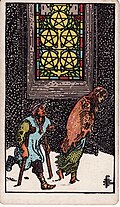
Two figures pass through a snowy foreground beneath a tall wall with a lit stained-glass window. Five gold pentacles are arranged within the window. One figure leans on a crutch and appears to have a wrapped or injured foot; the other is wrapped in a ragged cloak. Both are dressed for cold weather, yet the scene emphasizes exposure, movement, and deprivation rather than shelter.
The figures are shown in profile or angled side view, moving along the wall instead of entering it. Their heads and attention are lowered, while the illuminated window sits above them. Cool blue-gray snow and night tones contrast with the warmer yellow light and gold coins. Red and green details in the clothing add human color to an otherwise stark setting. The image does not identify the figures' history, diagnosis, morality, or destination; those claims would go beyond what is visible.
A. E. Waite's The Pictorial Key to the Tarot, published in 1911 and illustrated by Pamela Colman Smith, is an important public-domain source for RWS interpretation, not a universal dictionary for every deck. The window, the cold, and the travelers support a reading about need, visibility, and access. Modern practical application then asks what can be observed and changed in the reader's circumstances.
Keywords and Why They Fit
- Hardship and vulnerability: the exposed figures and snow show difficult conditions. Exclusion: the lighted window is visible but not visibly entered. Support-seeking: the travelers move together, and the nearby building presents a possible resource or community. Scarcity: five coins are present, but they are separated from the figures. Resilience: both people continue moving despite the weather. Shame or isolation: lowered posture can suggest an inward experience, but it must not be treated as a diagnosis or fact about a person.
These keywords arise from contrast: warmth and cold, light and exposure, coins and need, movement and an apparently closed boundary. The Five of Pentacles is not simply a bad-luck label. It asks whether the reading is showing an actual shortage, the fear of being left out, a support system that is hard to access, or a practical invitation to seek assistance.
Upright Five of Pentacles Meaning
Upright, the Five of Pentacles often brings attention to a period of reduced capacity, financial pressure, loneliness, uncertain belonging, or a resource gap. Its strength is honesty: name the missing item instead of pretending that willpower solves everything. Shared difficulty can also create solidarity, humility, and clearer knowledge of what kind of help is useful.
The risk of excess is identifying completely with lack. A person may overlook an available door, refuse support out of shame, or treat temporary conditions as a permanent identity. Practical actions include checking eligibility for assistance, asking a trusted person for a specific form of help, reviewing essential costs, documenting needs, and making a short plan for the next safe step. The card does not guarantee recovery, but it can make the support question visible.
Reversed Five of Pentacles Meaning
Reversed, this card does not automatically mean that hardship has ended or that a rescue is coming. It can show a blocked route to support, private distress, an excess of self-denial, a delay in recovery, or a change in direction. Sometimes the reversal describes help becoming more reachable; sometimes it shows that pride, shame, bureaucracy, or an unsafe arrangement still prevents access.
- Blockage: a door, conversation, benefit, payment, or support network is difficult to access. Internalization: fear, shame, or insecurity is carried privately and not communicated. Excess: deprivation becomes self-punishment, helplessness, overwork, or refusing every offer
- alternatively, repeated dependence may replace a sustainable plan. Delay: assistance, employment, housing, reconciliation, or practical relief requires more time or paperwork than expected. Direction adjustment: identify a different resource, make the request more specific, accept limited help, or change the plan without turning the reversal into a verdict.
A constructive reversed reading may therefore be modest and concrete: make one call, verify one document, tell one safe person what is needed, or replace an all-or-nothing expectation with a staged plan. If the issue concerns safety, health, law, or money, use qualified services and current evidence rather than tarot as the decision-maker.
Applications by Life Area
Relationships and emotions: the card can describe feeling left outside, a relationship under material strain, or two people sharing a difficult season. Upright, focus on honest requests and mutual care rather than shame. Reversed, ask whether vulnerability is being hidden or whether support is conditional. Do not use this card to claim what another person feels or to prove abandonment.
Work and study: upright, review workload, access, transportation, equipment, tuition, deadlines, and the support needed to continue. Strength may come from peer networks or asking for accommodations. Reversed, check for an unspoken obstacle, delayed response, or plan that depends on exhaustion; clarify requirements and seek appropriate institutional help.
Money and resources: treat the Five as a prompt to list essentials, income timing, debts, benefits, community resources, and immediate priorities. It is not investment, lending, legal, or financial advice. Reversed may suggest a budget gap becoming visible or a route toward assistance, but verify every option with records and qualified professionals.
Personal growth: examine the story that says needing help makes you lesser. Keep the card grounded: growth may mean accepting support, learning a practical skill, setting a boundary around scarcity, or recognizing another person's dignity without trying to save them. Small evidence-based steps matter more than dramatic declarations.
Five of Pentacles in Spreads
- One-card prompt: Where do I feel outside, under-resourced, or unable to reach support, and what is one safe next step? Three-card past, present, future: in the past, identify the origin of the shortage or exclusion
- in the present, name the actual gap and any visible support
- in the future, read the conditions that could change if a practical action is taken, not a guaranteed outcome. Situation, action, outcome: the situation locates need, the action specifies a request or resource check, and the outcome shows what that step may clarify. Relationship self, other person, interaction: Self examines your vulnerability and requests
- Other Person describes the observable role or pressure they bring, not their hidden mind
- Interaction studies reciprocity, distance, and access. Decision opportunity, risk, advice: Opportunity may be a support channel or honest reset
- Risk may be isolation, shame, or accepting unsafe terms
- Advice is to verify resources and ask for specific help. Obstacle, advice, outcome: obstacle names the closed route, advice chooses a realistic alternative, and outcome describes the practical effect of that adjustment.
Instructional Combination Reading
Instructional example, not a real case: Four of Pentacles beside Five of Pentacles can show how fear of losing security becomes isolation, but it may also describe a necessary reserve during a difficult period. Five of Pentacles beside Six of Pentacles shifts attention toward exchange: a request, offer, or redistribution may become visible, yet the surrounding cards should test whether the arrangement is respectful and sustainable. Adjacent cards modify the question; they do not guarantee rescue or assign blame.
Common Misreadings, Traditions, and Responsible Use
The most common error is reading this card as certain poverty, illness, homelessness, or punishment. Its imagery can symbolize real hardship, but a card cannot diagnose, forecast a person's finances, or establish why a condition exists. Another error is assuming the lit window proves help is immediately available. Read access, consent, timing, and evidence in the actual situation. RWS-based readers may emphasize exclusion and material insecurity; Marseille pip-card readers may rely more on the number five, suit structure, and local conventions. Other decks may change the scene entirely.
Use tarot as cultural study, symbolic interpretation, and self-reflection, not scientifically validated prediction. Do not use it for medical, legal, investment-return, housing, or guaranteed-fate decisions, and do not use it to read a third party's mind. In urgent situations, contact appropriate emergency, social, health, legal, or financial services. A responsible reading increases choices and dignity rather than fear.
Tarot Journal Prompts
- What specific resource or form of belonging feels absent? What support is visible but difficult to approach, and what would make the request safer? Which part of my scarcity story is supported by current evidence? How can I offer or receive help without creating shame or control?
Suggested Learning Links
For sequence context, read the independent Four of Pentacles article at tarot-card-four-of-pentacles and continue to Six of Pentacles at tarot-card-six-of-pentacles. For foundations, use Tarot for Beginners at tarot-for-beginners, the Pentacles suit guide at tarot-pentacles, Upright and Reversed Tarot at tarot-upright-and-reversed, How to Ask Tarot Questions at tarot-how-to-ask, Three-Card Tarot Spreads at three-card-tarot-spreads, and Tarot Journal Review at tarot-journal-review. These resources add method without replacing this card-specific analysis.