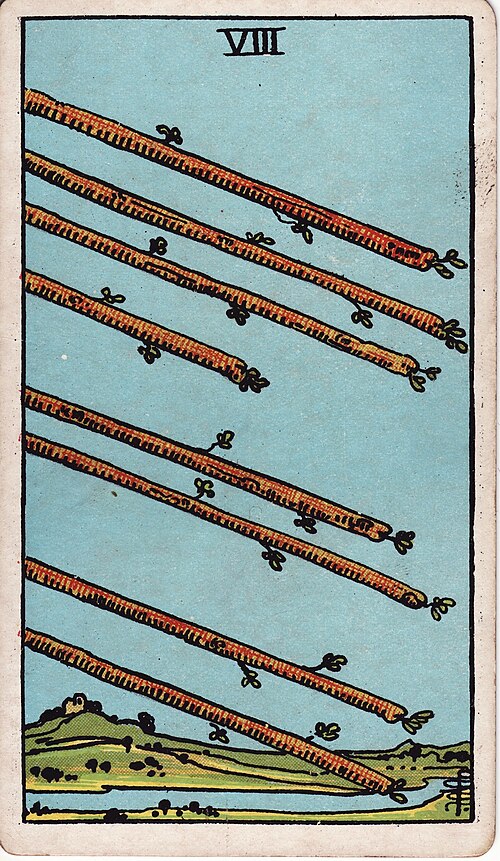
Eight of Wands at a glance
The Eight of Wands is Minor Arcana, suit of Wands, rank Eight, and sequence position 30 in this RWS series. It follows the Seven of Wands and comes before the Nine of Wands. Its central dynamic is acceleration: energy, news, travel, or a decision moves from preparation into transmission. Speed can reduce hesitation and connect separate points, but it can also outrun checking, consent, or available resources. The card does not guarantee a message, romance, journey, or event on a particular date. Read it as a prompt to examine pace, direction, timing, and what must be confirmed before movement becomes commitment.
Historical and deck context
The Eight of Wands belongs to the scene-based Rider-Waite-Smith tradition associated with A. E. Waite's system and Pamela Colman Smith's illustrations. The 1911 edition of Waite's The Pictorial Key to the Tarot is catalogued under Waite's name and credits Smith for the illustrations. Waite's historical divinatory layer, later tarot teaching, and modern self-reflection do not carry identical meanings. This article therefore separates visible structure from traditional associations and treats practical advice as an editorial reading method, not as proof of scientifically validated prediction.
RWS visual language
Eight long brown wands appear suspended in a clear sky, arranged in parallel diagonal lines. Their shared angle gives the appearance of movement from the upper-left area toward the lower-right area, although the card does not show hands, riders, or a visible source for the motion. Below them is an open green landscape with distant hills and a band of blue water or river. There is no central human figure to slow the scene with a personal expression or debate. The repeated staves are similar in size and direction, so alignment is more prominent than conflict; the open space around them makes the speed feel exposed and uninterrupted. These observable choices support a reading about momentum and transmission without requiring the reader to claim that a specific message or journey will occur.
Keywords and how they follow from the card
The concise keyword set is speed, communication, alignment, release, momentum, and timing. Speed follows from the airborne diagonal staves and the absence of a resting figure. Communication follows from several separate objects traveling along a shared visual route, a traditional extension rather than a literal letter in the image. Alignment follows from the parallel arrangement. Release follows from the sense that the wands have left a hand or starting point, even though that source is not shown. Momentum follows from repeated direction and open space. Timing is central because the card describes motion through an interval, not a permanent state. These keywords are flexible tools whose emphasis changes with the question and position.
- Speed and acceleration
- messages or transfer
- aligned effort
- release into motion
- momentum
- timing that still requires verification.
Upright meaning
Upright, the Eight of Wands suggests that a process is ready to move, a message can travel, or several actions may converge quickly. Its strengths are responsiveness, clean handoffs, reduced delay, enthusiasm, and the ability to act while a window is open. In study or work, it can favor sending the draft, scheduling the meeting, making the call, or breaking a long plan into linked actions. Its risks of excess are rushing, replying before understanding, mistaking volume for progress, and allowing a fast schedule to eliminate rest or review. Practical action is to identify the destination, sequence the next few steps, set a check point, and communicate the essential information in plain language. Move quickly where the facts are sufficient; pause where consent, safety, money, or irreversible consequences are involved.
- Strengths: responsiveness, clear transfer, coordinated effort, and timely action. Risks: haste, information overload, scattered priorities, and decisions made before review. Action: define the destination, send what is ready, and preserve a verification point.
Reversed meaning
Reversed does not simply mean that nothing will happen. Blockage may show crossed signals, missing infrastructure, a route that is not open, or too many moving parts competing for the same channel. Internalization can appear as an urgent inner monologue, excitement that has not yet become an outward conversation, or a plan rehearsed privately but never sent. Excess may be rapid-fire messaging, impulsive travel, multitasking, or acting on adrenaline rather than information. Delay can indicate a late reply, rescheduled movement, a stalled delivery, or a necessary pause while details are corrected. Direction adjustment is to slow the channel, confirm the recipient and destination, send one clear message, and sequence tasks instead of pushing everything at once. A reversal can be useful when it exposes false urgency and creates room for a safer, more accurate launch.
- Blockage: the route or channel is not ready. Internalization: urgency remains unexpressed or untested. Excess: haste and overload. Delay: news, travel, or progress arrives late. Adjustment: verify details, reduce simultaneous tasks, and restart with a clear destination.
Relationships, emotions, work, resources, and growth
In relationships and emotions, the upright card can describe prompt contact, an honest conversation gaining momentum, shared enthusiasm, or a change from waiting to doing. It does not reveal another person's feelings or promise a particular romantic outcome. Reversed may point to delayed replies, mixed signals, emotional flooding, impulsive messages, or a need to let a conversation cool before continuing. In work and study, the card supports deadlines, presentations, travel, applications, and coordinated teamwork, provided a review step remains. For money and resources, it may suggest a payment moving, a transaction being processed, or the need to act on timely information; it is not a guarantee of income, market performance, or investment return. Check terms, dates, balances, and risks. For personal growth, practice distinguishing urgency from importance. A useful exercise is to choose one message, one task, and one time for review rather than treating every impulse as a command.
Spreads and position changes
For a one-card prompt, ask, “What is ready to move, and what must be checked before it does?” The emphasis is on a safe next transmission rather than a guaranteed event. In a three-card past, present, future spread, the card may show earlier momentum that set events in motion, current acceleration, or a future opening that depends on preparation; it is not a fixed date or outcome. In a situation, action, outcome spread, it describes the current pace in Situation, recommends a concise and well-sequenced response in Action, and in Outcome suggests rapid development whose quality depends on communication and follow-through. In relationship positions, Self shows how you initiate, answer, or regulate emotional speed; Other Person describes the role that person presents in the situation rather than private thoughts; Interaction shows whether the exchange is aligned, rushed, delayed, or mutually responsive. In a decision spread, Opportunity may be a time-sensitive opening or efficient channel, Risk may be haste, overload, or incomplete consent, and Advice may be to act on verified information while keeping an exit or review point. In Obstacle, the card can show too much speed or broken communication; in Advice, clear sequencing; in Outcome, movement that reflects the quality of the choices made before launch.
Instructional combination example
Instructional example, not a real case: Seven of Wands beside the Eight of Wands can turn a defensive stance into a prompt boundary statement. The Seven supplies the need to protect standards; the Eight asks for a direct message before pressure multiplies. Eight of Wands beside Nine of Wands can modify speed with caution: progress may continue, but fatigue and prior experience need to shape the pace. Adjacent cards show conditions around momentum; they do not prove that a particular message will arrive or that an event is inevitable.
Common misreadings, traditions, and responsible use
A common misreading is “the Eight of Wands always means fast romance or instant good news.” The RWS image shows airborne, aligned staves over open land; it does not specify the subject, emotional tone, sender, date, or result. Another mistake is to treat acceleration as automatically beneficial. Sometimes the correct reading is to remove friction; sometimes it is to stop an unsafe rush. In Marseille-style pip cards, the Eight of Wands may be read through number, suit pattern, symmetry, color, and neighboring cards rather than a scene of airborne objects. Modern decks may change the landscape or depict people. RWS and Marseille traditions also differ in the numbering of Strength and Justice: RWS places Strength at VIII and Justice at XI, while Marseille commonly reverses those positions; their imagery and correspondence systems differ too. This series uses RWS numbering and primary image analysis. Tarot is a cultural, symbolic-reading, and self-reflection tool, not scientifically validated predictive power. Do not use this card to read a third party's mind, diagnose a medical issue, decide a legal dispute, or promise investment returns. For high-stakes choices, verify facts and consult qualified professionals.
Journal prompts and learning links
Journal prompts: Where is speed genuinely useful right now? What information must be checked before I act? Which message could be made shorter and clearer? What would a sustainable pace look like after the first burst of momentum? Suggested learning links are the previous card, Seven of Wands, at tarot-card-seven-of-wands; the next card, Nine of Wands, at tarot-card-nine-of-wands; and the foundational guides Tarot for Beginners at tarot-for-beginners, Tarot Wands at tarot-wands, Upright and Reversed Tarot at tarot-upright-and-reversed, How to Ask Tarot Questions at tarot-how-to-ask, Three-Card Tarot Spreads at three-card-tarot-spreads, and Tarot Journal Review at tarot-journal-review. These links add method and suit context without replacing this card's individual meaning.