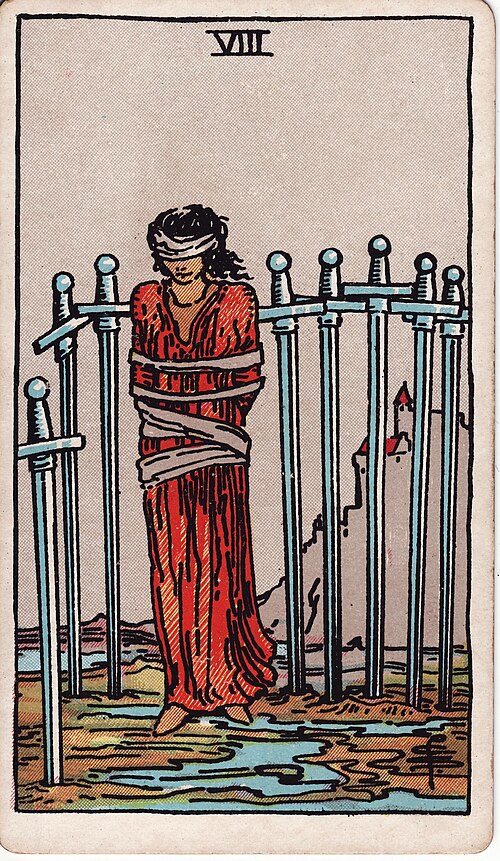
Eight of Swords in the RWS Sequence
The Eight of Swords is Minor Arcana VIII of the Swords suit and position 58 in this 78-card RWS sequence. Swords organize thought, communication, judgment, boundaries, conflict, and decisions. The number eight brings structure, repetition, and a system of limits into that mental field. The card often describes feeling trapped by circumstances, beliefs, fear, or incomplete information, while leaving open the practical question of what freedom, support, or clearer evidence might still be available.
This series uses the Rider-Waite-Smith order: Strength is VIII and Justice is XI. In many Marseille-style sequences, Justice is VIII and Strength is XI, and Marseille pip cards and other decks may present different imagery from the illustrated RWS minors. These are school and deck differences, not reasons to collapse traditions into one meaning. Here the primary analysis begins with the visible RWS scene and then distinguishes traditional interpretation from modern self-reflection.
What the RWS Image Shows
A blindfolded figure stands on muddy or muted ground, with her hands bound behind her. Eight upright swords form a loose enclosure around her. She wears a red or warm-toned garment, while the sky and distant landscape are blue-gray and subdued. A castle or fortified structure appears on a rise in the background. The swords surround her, but the arrangement is not a solid wall: spaces remain between them, and the ground offers a direction of movement even though the figure cannot easily see it.
The image visibly combines vulnerability with an incomplete enclosure. The blindfold limits immediate sight, the bindings limit the hands, and the swords make the surrounding danger unmistakable. Yet the scene does not show a sealed cell or a permanent prison. Traditional readings develop these details into restriction, anxiety, self-limiting stories, and the need to challenge assumptions. That interpretation should not become blame: a person can face real external limits, unequal power, disability, danger, or missing resources. The card invites a careful inventory of constraints rather than a simplistic claim that everything is imaginary.
Keywords from Image and Tradition
- Restriction and vulnerability: the bindings, blindfold, and ring of swords visibly reduce the figure's available movement and information. Mental framing: because the swords leave gaps but sight is blocked, the card can symbolize how a partial view makes every option appear closed. Fear and uncertainty: the muted atmosphere and exposed figure suggest caution before action, without proving that catastrophe will follow. Latent agency and release: the incomplete enclosure leaves room for a next step, a request for help, or a change in direction, so possibility remains a prompt rather than a guaranteed outcome.
Upright Eight of Swords Meanings
Upright, the Eight of Swords describes a narrowed field of action. A person may be constrained by policy, money, timing, another person's power, a physical environment, or a repeated thought pattern. Its strength is diagnostic honesty: pause, identify what is actually binding the situation, and avoid pretending that confidence alone solves a material problem. The card can encourage careful preparation, support-seeking, consent, and a smaller step that does not require perfect certainty.
Its risk is paralysis through overthinking, catastrophizing, self-silencing, or treating a first interpretation as the only possible one. Excess can turn caution into delay and protection into dependence on fear. A practical upright response is to separate facts from predictions, list available resources, ask one precise question, and choose the safest reversible action. If the limit is external, name it and seek appropriate help; if an assumption is untested, design a modest way to check it. The card does not promise that the obstacle will vanish, but it can improve the quality of the next choice.
Reversed Eight of Swords Meanings
Reversed, the Eight of Swords is not automatically a happy release or proof that the problem was self-created. It may show blockage becoming more internal: the person is physically able to act but cannot yet trust their judgment, ask for help, or imagine an alternative. It may also show excess, such as panic, avoidance, or self-criticism becoming so loud that ordinary decisions are delayed. Delay can appear when a person keeps waiting for complete certainty before moving.
A constructive reversal can indicate that a binding story is loosening, that support has arrived, or that a previously hidden option is becoming visible. Direction adjustment means changing the method, not forcing a dramatic escape: remove one assumption, renegotiate one boundary, consult a qualified person, document a choice, or take a supported step. Reversed emphasis can also warn that apparent freedom is premature if the external danger or material constraint remains. Check the environment as well as the mind, and let the surrounding cards distinguish release from disorientation.
Applications by Life Area
- Relationships and emotions: The card can describe hesitation, difficulty speaking, fear of conflict, or a bond in which one person feels they have no safe options. Ask what would make communication safer and more direct. Do not use it to diagnose a partner, prove what someone feels, or pressure a person to leave before support is available. Reversed, practice one honest boundary or one request for help rather than demanding instant emotional clarity.
- Work and study: Look for unclear instructions, excessive review, fear of evaluation, inaccessible systems, or a belief that one mistake ends the path. Break the task into observable requirements, request feedback, and build a realistic timetable. Reversed, release perfectionism gradually, but do not ignore a real workload, discrimination, or unsafe condition.
- Money and resources: The image can mirror financial anxiety, a lack of options, or fear of opening an account, bill, contract, or budget. Gather facts, list deadlines, and seek qualified financial or legal guidance when needed. It does not predict insolvency, theft, or a guaranteed rescue, and tarot cannot replace a sound plan.
- Personal growth: Observe the story that says you cannot move, then distinguish a protective caution from an inherited belief. Growth may be asking for support, learning a skill, leaving an unsafe situation with a plan, or accepting that progress can be incremental. Agency is not the same as blame.
Reading the Card in Spreads
In a one-card draw, ask: Which constraint is real, which assumption is untested, and what safe support or next step is available today? In a three-card past, present, future spread, the past may show how the limiting pattern formed, the present may show the current bind and missing information, and the future may show whether a chosen support or reframe changes the field. In a situation, action, outcome spread, the situation position emphasizes the narrow view; action asks for fact-checking, support, or a carefully bounded experiment; outcome shows the direction of the current pattern rather than a fixed sentence about fate.
In relationship positions, Eight of Swords for self may highlight your fear, silence, or genuine lack of safe choices; for the other person, it should be read as a prompt about the interaction's conditions, never as access to their private mind; in the interaction position, it can describe mutual hesitation, an unspoken rule, unequal power, or a communication loop. In decision positions, opportunity may be a chance to identify a workable opening, risk may be paralysis or ignoring external danger, and advice may be to obtain information and support before committing.
For obstacle, advice, and outcome positions, the obstacle can be a blind spot, fear-based repetition, missing accommodation, or a material barrier. Advice shifts the card toward naming the bind, loosening one knot, and choosing a safe method of assistance. Outcome may show continued restriction if nothing changes, or a gradual opening if evidence, boundaries, and support are added. The position changes the emphasis; the Eight of Swords is not a fixed answer of imprisonment.
Combination Reading: Instructional Example
Instructional example, not a real case: place Seven of Swords beside Eight of Swords. The Seven's private strategy or avoidance can become the Eight's feeling of confinement when too much is carried alone or too little is communicated. Read in the other direction, the Eight may explain why the Seven chooses an indirect route: the person perceives no safe direct option. Add Nine of Swords and the pattern can become internal worry; add Six of Swords and a supported transition may give the strategy somewhere constructive to go. Adjacent cards modify the story; none proves deception, abuse, or a predetermined result.
Common Misreadings, Deck Differences, and Responsible Use
A common misreading says the Eight of Swords means that all restrictions are imaginary and that anyone can simply think their way free. That can erase real poverty, illness, disability, coercion, discrimination, or danger. Another misreading treats the blindfold as proof of ignorance or a reversed card as instant liberation. In the RWS, the illustrated scene supplies a narrative of a bound figure and a loose ring of swords; Marseille-style pips and other decks may use different visual evidence, so readers may lean more on number, suit, position, and neighboring cards. Some schools do not use reversals and locate these tensions through context instead.
Tarot is a cultural, symbolic-reading, and self-reflection practice, not a scientifically validated predictive system. Do not use this card to read a third party's mind, label someone with a mental-health condition, give medical, legal, financial, or safety instructions, or guarantee that a person will escape a situation. When there is immediate danger or coercion, prioritize qualified professionals, trusted support, emergency services, and a practical safety plan. A useful reading should expand careful agency without blaming someone for the limits they face.
Journal Prompts and Suggested Learning Links
- 1. What part of this situation is an observable constraint, and what part is an assumption or prediction? 2. What support, accommodation, information, or boundary would make the next step safer? 3. What is one small action that tests an option without demanding an irreversible leap? 4. If the blindfold came off for a moment, what fact would I want to verify first?
Suggested learning links: read the previous card, Seven of Swords (tarot-card-seven-of-swords), for strategy, privacy, and unfinished responsibility; continue to the next card, Nine of Swords (tarot-card-nine-of-swords), for the movement from external-looking restriction toward anxious thought; and use the Swords suit guide (tarot-swords) for the suit's broader language. The foundational Tarot for Beginners guide (tarot-for-beginners), Upright and Reversed guide (tarot-upright-and-reversed), Three-Card Tarot Spreads guide (three-card-tarot-spreads), Tarot Journal and Review guide (tarot-journal-review), and How to Ask Tarot Questions guide (tarot-how-to-ask) provide methods for reflective, non-deterministic practice.