Eight of Pentacles at a glance
The Eight of Pentacles is Minor Arcana, Pentacles suit, rank Eight, and position 72 in the 78-card Rider-Waite-Smith (RWS) sequence. It follows the Seven of Pentacles and comes before the Nine of Pentacles. The card concentrates on practice: a tangible skill is improved through repetition, attention, and standards that can be checked. Pentacles connect that practice to work, craft, resources, the body, and the material world. Eight therefore asks how a person turns intention into reliable ability rather than merely admiring a goal.
This series follows the RWS order and uses the RWS image for primary analysis. RWS and Marseille traditions differ in the numbering of Strength and Justice and in some imagery: RWS places Strength at VIII and Justice at XI, while many Marseille decks place Justice at VIII and Strength at XI. For the Minor Arcana, an RWS scene can make the work narrative visually explicit, whereas a Marseille pip card may call for more attention to number, suit, arrangement, and surrounding cards.
RWS visual analysis
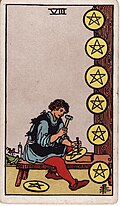
The RWS image presents a single craftsman seated at a workbench, turned toward the pentacle he is shaping. A hammer is raised or engaged in the task, making the action visibly repetitive and deliberate. Other gold pentacles are displayed in a vertical row on the nearby structure, while a town or built landscape appears in the distance. The scene uses warm yellow coins, earthy browns and greens in the clothing and ground, a gray work surface or wall, and a pale blue-gray sky. The figure faces the immediate task rather than the distant settlement.
The repeated coins create a visual record of completed units, while the coin under the tool shows a unit still being made. The bench gives the work a stable setting; the distant town suggests that skill can serve a wider community, livelihood, or future role without proving a particular career outcome. Traditional readings extend these visible details into apprenticeship, diligence, craftsmanship, and focused labor. Those are cultural and interpretive associations, not evidence that the card can guarantee employment, income, or recognition.
Keywords and how they arise
- Craft follows the tool, workbench, and shaped coin
- repetition follows the row of similar pentacles
- apprenticeship follows a person learning through supervised or self-directed practice
- focus follows the figure's attention to one immediate task
- quality follows the visible comparison between completed and unfinished work
- productive routine follows the orderly setting
- materialization follows the movement from effort to a tangible object. The keywords describe reading directions grounded in image and suit, not an unexplained list of promises.
Upright Eight of Pentacles meanings
Upright, the Eight of Pentacles is the card of deliberate practice and useful competence. It favors showing up, breaking a large ambition into repeatable tasks, accepting instruction, and improving through feedback. Its strength is not glamorous speed but dependable progress: the craftsperson can inspect a result, adjust a technique, and make the next version better. It can describe study, a trade, writing, software, cooking, physical training, administration, or any process where consistency matters.
The card's risk is excess devotion to output. Repetition can become narrow perfectionism, overwork, or the belief that a person earns dignity only by being useful. A practical upright action is to choose one skill, define a quality standard, schedule focused sessions, and include rest and review. Seek a teacher or peer when appropriate, and record what actually improves. Skill is built by practice, but practice should serve a meaningful life rather than consume every other value.
Reversed Eight of Pentacles meanings
Reversed, the card does not automatically indicate incompetence or a bad result. It can reveal a blockage in learning: scattered attention, poor instruction, fear of being assessed, or a task broken into steps that are too vague. Internalization may appear as private insecurity, hiding unfinished work, or practicing alone without useful feedback. Excess may show repetitive labor, perfectionism, workaholism, or polishing details that do not matter to the real goal.
- For blockage, identify the exact skill or next repetition instead of calling the whole project impossible. For internalization, share a draft, ask a specific question, or let a trusted reviewer see the learning process. For excess, set a stopping rule and protect sleep, health, relationships, and nonproductive time. For delay, check whether the routine is too ambitious, the tools are wrong, or the task is waiting for feedback that has not been requested. For direction adjustment, change the curriculum, mentor, workflow, scale, or definition of quality. Reversed can also mean practice is happening quietly before a public demonstration, so look for evidence before judging it negatively.
Applications in ordinary life
- Relationships and emotions: The Eight of Pentacles favors care expressed through dependable behavior and the willingness to learn a better way of communicating. It can point to a relationship that needs repeated small repairs rather than one dramatic promise. Its shadow is treating a partner as a project, demanding perfection, or using busyness to avoid emotional presence. Ask what practice is mutual and what conversation cannot be replaced by effort.
- Work and study: This is a direct prompt to build a portfolio, study schedule, apprenticeship plan, or feedback loop. Break the outcome into observable exercises and review quality at intervals. Reversed, examine training gaps, unclear expectations, repetitive low-value work, and burnout before simply adding hours.
- Money and resources: The card can suggest developing a marketable skill, improving a process, maintaining tools, or valuing labor fairly. It does not predict a salary, investment return, or guaranteed client demand. Compare training costs, time, alternatives, and practical evidence before committing resources.
- Personal growth: Practice a behavior that expresses a value, such as listening, organizing, or setting a boundary. Track repetitions without turning the journal into a scorecard for self-worth. Rest, play, and changing direction are part of sustainable mastery.
Eight of Pentacles in spreads
For a one-card prompt, ask: What skill or repeatable action deserves focused practice now? The card may emphasize a routine, a teacher, a quality check, or a healthier stopping point. In a three-card situation, action, outcome spread, the situation position shows the present level of skill and working conditions, the action position asks what to practice or refine, and the outcome position describes what becomes more reliable if the method is sustained. In a past, present, future spread, it can mark training already completed, current disciplined work, or a future apprenticeship; the position determines the time emphasis.
- In a relationship spread, Self asks how you are practicing care, honesty, or repair
- Other Person describes the observable role or effort represented in the reading rather than claiming access to private thoughts
- Interaction shows whether the relationship has a workable feedback loop or has become a performance review. In a decision spread, Opportunity points to learning, a craft, or a process that can compound
- Risk points to overwork, narrow specialization, or a poor return on effort
- Advice recommends a small experiment with clear standards. In obstacle, advice, outcome positions, the card can show an untrained skill as the obstacle, disciplined repetition as advice, or a result based on accumulated competence. It changes emphasis by position instead of supplying a fixed yes or no.
Instructional combination example
Instructional example, not a real case: Seven of Pentacles beside the Eight of Pentacles changes a vague question about waiting into a practical review of technique and evidence. The Seven asks whether the investment is worth tending; the Eight asks what specific practice can improve the result. Beside the Nine of Pentacles, the Eight can emphasize skill becoming self-sustaining or visible, while the Nine also asks whether independence and enjoyment are being protected. Adjacent cards refine the work question; they do not promise a particular reward.
Common misreadings, traditions, and responsible use
A common misreading is reducing the Eight of Pentacles to tedious labor or guaranteed career success. The image shows focused making, not an employer's promise or a universal command to work harder. Another mistake is assuming repetition is always virtuous; repeated practice can reinforce a bad method. In RWS-style decks, the illustrated craftsman supplies a clear narrative of production. In Marseille and other pip-based or redesigned decks, the same number and suit may be read through pattern, numerology, elemental theory, or a different visual language. Modern psychological and traditional esoteric schools may disagree about correspondences, so state which method is guiding the interpretation.
Tarot is a cultural, symbolic-reading, and self-reflection tool, not a scientifically validated predictive system. Do not use this card as medical, legal, or investment-return advice, and do not infer a third party's thoughts or intentions from it. A spread cannot replace a contract, teacher, clinician, financial professional, direct consent, or a realistic workload assessment. Use the card to create a question, test a small action, and review real feedback while keeping responsibility for decisions with the people involved.
Tarot journal prompts
- What one skill would most improve my present situation if I practiced it consistently?
- What feedback or standard would distinguish useful repetition from busywork?
- Where has perfectionism replaced learning, rest, or honest communication?
Suggested learning links
Read the preceding Seven of Pentacles article at tarot-card-seven-of-pentacles, then continue to the Nine of Pentacles at tarot-card-nine-of-pentacles. For foundations, use Tarot for Beginners at tarot-for-beginners, the Pentacles suit guide at tarot-pentacles, Tarot Upright and Reversed at tarot-upright-and-reversed, Three-Card Tarot Spreads at three-card-tarot-spreads, and Tarot Journal Review at tarot-journal-review. These foundational articles explain method, spread structure, and review habits that help keep this individual card reading grounded.