Eight of Cups at a glance
The Eight of Cups is Minor Arcana VIII in the Cups suit and the eighth numbered Cups card. In the 78-card RWS sequence it is position 44: it follows the twenty-two Major Arcana cards, fourteen Wands cards, and seven earlier Cups cards. Its central question is “What am I willing to leave, and what meaning am I seeking beyond what is familiar?”
This series follows the Rider-Waite-Smith order and uses the RWS scene for primary image analysis. RWS and Marseille traditions differ in the numbering of Strength and Justice and in some imagery; Marseille pip cards do not present the same illustrated narrative. In the RWS convention used here, Strength is VIII and Justice is XI, while the Eight of Cups is a scenic Minor Arcana card.
A. E. Waite’s The Pictorial Key to the Tarot, published in 1911 and associated with illustrations by Pamela Colman Smith, is a period source for traditional descriptions. It helps distinguish early twentieth-century commentary from later popular keywords. The practical meanings in this article are symbolic and reflective, not scientifically validated forecasts.
What the RWS image shows
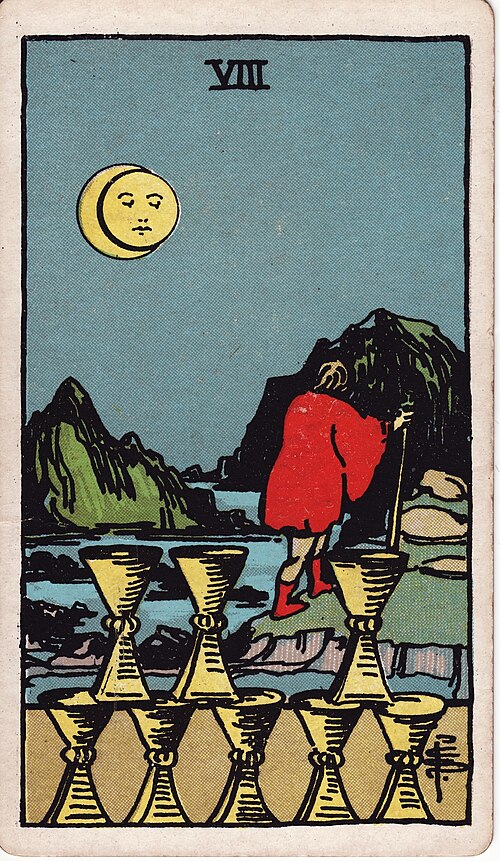
Eight upright cups sit in a compact arrangement near the water, with a visible separation in the upper structure that makes the group feel incomplete or carefully assembled rather than abundant. A traveler in a red cloak turns away from the cups and walks toward the uneven mountains. The figure carries a staff, suggesting support for a journey, and is shown in profile rather than facing the reader.
A large moon hangs above the landscape. Its face and changing phases invite several traditional readings, but the visible image is enough to say that the traveler moves at night under uncertain light. Blue water, dark hills, gray rock, and the red garment create contrast between inward feeling, difficult terrain, and deliberate motion. The cups remain behind; they are not smashed or overturned.
The direction away from the cups is the scene’s strongest action. This is not an image of sudden destruction. It depicts a chosen or necessary departure, undertaken without a clear map of the destination. The gap in the cups and the distant mountains make room for the possibility that leaving is both an ending and a search.
Keywords derived from the image
Useful keywords are departure, release, emotional truth, seeking, disappointment, boundaries, and transition. Departure and release follow from the traveler’s back and movement away; seeking follows from the mountain path and moonlit distance. Emotional truth names the recognition that a familiar arrangement no longer meets a deeper need. Disappointment is possible but not required: the cups are still upright. Boundaries and transition describe the practical work of leaving without turning the card into a promise of escape.
Upright Eight of Cups meaning
Upright, the Eight of Cups often marks a deliberate decision to step away from an emotional pattern, role, goal, or arrangement that has become insufficient. Its strength is honest disengagement. The card can support a respectful ending, a change of direction, a sabbatical, or a search for a more meaningful standard. It asks for courage because the next landscape is not fully known.
The risk is romanticizing departure. Leaving can be brave, but it can also become avoidance, silent withdrawal, or repeated dissatisfaction. The card does not say that every difficult situation should be abandoned, and it does not promise that a new place will solve an old pattern. Before acting, identify what is ending, what has been tried, what remains unfinished, and what support the journey requires.
A practical upright action is to make a departure plan. Name the boundary, communicate it clearly where appropriate, preserve essential records and resources, and define a review point. If the issue is a project or habit rather than a relationship, distinguish “this no longer serves the goal” from “this is temporarily uncomfortable.” A small, ethical step can test whether the direction is real.
Reversed Eight of Cups meaning
Reversed, the card’s departure theme may appear as blockage, internalization, excess, delay, or direction adjustment. Blockage can mean feeling unable to leave because of money, duty, fear, or an unresolved attachment. Internalization can show grief, regret, or a private search that has not yet been explained to anyone. Excess can become restless quitting, emotional disappearance, or treating every ordinary difficulty as proof that one must start over.
Delay may indicate waiting for permission, perfect certainty, or a dramatic sign instead of preparing a realistic transition. Direction adjustment can be constructive: return to a conversation, renegotiate a commitment, repair what is repairable, or discover that the true departure is from an expectation rather than a person or place. Reversed is not automatically negative; it may describe a careful return or a pause for support. Upright is not automatically positive; an abrupt exit can still cause harm.
Applications in ordinary life
In relationships and emotions, the Eight of Cups can describe emotional distance, a conscious ending, a boundary, or the need to stop repeating a circular conversation. It is not permission to announce what another person feels. Ask directly, protect privacy, and plan for practical consequences. Reversed, explore whether the relationship needs repair, a clearer boundary, or a supported exit; do not confuse avoidance with self-care.
For work and study, the card can point to leaving a role, course, method, or ambition that no longer fits. Its constructive action is a transfer plan: compare alternatives, check deadlines, secure references or records, and identify the skill that carries forward. Reversed, look for burnout, fear of evaluation, or a pattern of abandoning projects just before learning compounds.
For money and resources, it asks what an exit will cost and what resources make it sustainable. Do not interpret it as guaranteed financial loss or as investment advice. Before resigning, relocating, or ending a contract, check cash flow, obligations, notice periods, and independent professional guidance. Reversed, delay may be prudent while a safer bridge is built.
For personal growth, the Eight of Cups supports outgrowing an identity and grieving a former source of meaning. Growth is not measured by how far one runs. It is measured by whether the new direction is chosen with awareness, responsibility, and room for learning.
Reading the Eight of Cups in spreads
One-card prompt: “What is no longer nourishing me, and what would a responsible next step toward meaning look like?” The emphasis is on a clear boundary or experiment, not a guaranteed departure.
In a three-card situation, action, outcome spread, the Eight of Cups in the situation position shows a threshold: an arrangement may be emotionally complete or under review. In action, it recommends naming what to release and preparing the route. In outcome, it suggests distance, a changed relationship to the past, or a search that continues; the surrounding cards show whether the movement is supported or avoidant.
In a relationship spread, as self it can show a need for space, an ending, or the courage to stop accepting an incomplete exchange. As the other person, it describes how their visible participation or withdrawal is represented, not their unspoken feelings; ask rather than mind-read. As interaction, it highlights emotional distance, a shared transition, or the need to decide whether to repair or part.
In a decision spread, as opportunity it may reveal a meaningful exit, a new field of study, or freedom from an unhelpful expectation. As risk it warns of leaving without a plan, abandoning repair too early, or assuming the next option will be better. As advice it says to define the ending, communicate responsibly, and carry forward what remains useful.
As obstacle, the card can show attachment, fear of emptiness, or a habit of disappearing instead of negotiating. As advice, it asks for a boundary and a route rather than a dramatic gesture. As outcome, it emphasizes a transition, changed priorities, or a continuing search; it should not be read as a fixed prediction of separation.
Instructional combination reading
Instructional example, not a real case: Seven of Cups beside the Eight of Cups can show imagined possibilities becoming a decision to leave one unsatisfying arrangement; the reader should still test whether the departure is values-based or escapist. Eight of Cups beside Nine of Cups can contrast a search for deeper meaning with a comfortable wish already fulfilled. Adjacent cards modify the question and emphasis; they do not guarantee an event.
Common misreadings, traditions, and boundaries
The most common misreading is “the Eight of Cups always means a breakup.” Its visible action is departure, but the object may be a habit, role, belief, project, or emotional bargain. Another error is treating the moon as proof of deception or the missing-looking space among the cups as a single fixed doctrine. RWS readers may emphasize the scene and narrative; Marseille readers may begin with the number, suit, and arrangement of pips. Reversal practices, elemental correspondences, and psychological versus divinatory approaches also vary by school.
Use this card for cultural learning, symbolic reading, and self-reflection, not as scientifically validated prediction. It cannot determine another person’s mind, guarantee a future, or replace medical, legal, financial, academic, or safety advice. For a high-stakes departure, gather facts, make a safety plan, and consult qualified professionals. Tarot should widen responsible agency, not create fear or dependence.
Tarot-journal prompts
- 1. What am I leaving, specifically, and what am I carrying forward?
- 2. Is this departure a boundary, an avoidance pattern, or a values-based transition?
- 3. What practical support would make the next step safer and more honest?
Suggested learning links
Previous card: Seven of Cups Tarot Card (tarot-card-seven-of-cups). Next card: Nine of Cups (tarot-card-nine-of-cups). Foundational reading: Tarot for Beginners (tarot-for-beginners), How to Ask Tarot Questions (tarot-how-to-ask), Tarot Upright and Reversed (tarot-upright-and-reversed), Tarot Journal and Review (tarot-journal-review), and Three-Card Tarot Spreads (three-card-tarot-spreads). These resources add method and context without replacing this card-specific article.