Death at a Glance
Death is Major Arcana XIII and the fourteenth card in the 78-card Rider-Waite-Smith sequence, with The Fool numbered 0. In a symbolic reading, the card concerns endings, transition, clearing, and the conditions for renewal. It does not automatically predict a physical death, disaster, or an irreversible event. Its practical question is more precise: what form, role, belief, or arrangement has reached the end of its useful life, and what must be acknowledged before something different can begin?
This article follows the RWS order and primary image. The Marseille tradition differs in the numbering of Strength and Justice and in some imagery; RWS places Strength at VIII and Justice at XI. Waite's The Pictorial Key to the Tarot, associated with the RWS tradition and illustrated by Pamela Colman Smith, provides a historical interpretive reference. The applications here are modern editorial synthesis. Tarot is presented as cultural symbolism and a self-reflection tool, not as a scientifically validated forecasting method.
What the RWS Image Shows
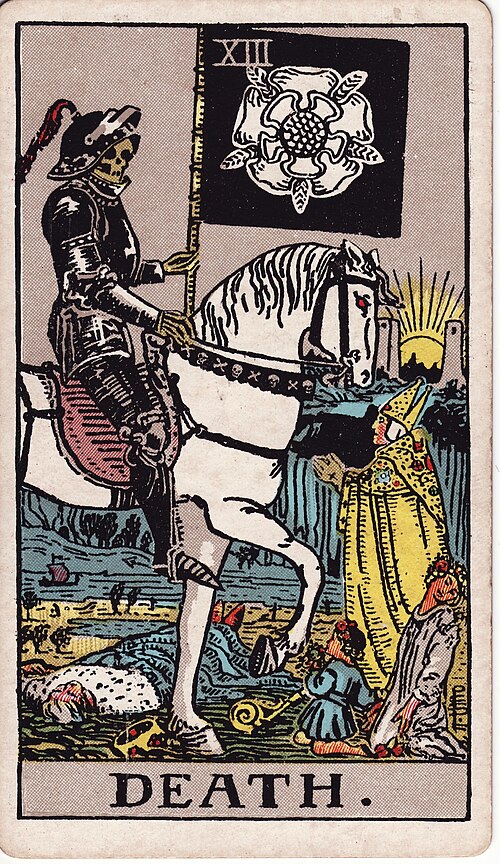
A skeletal rider in dark armor sits on a white horse that faces toward the right side of the card. The rider carries a black banner marked with a pale five-petaled rose. A fallen crowned figure lies in the foreground, while other human figures kneel or stand nearby, making the scene a public encounter with change rather than a private thought. In the distance, a river leads toward two gray towers, and a bright sun appears between them. The palette contrasts black armor and banner with the horse's white body, red details, yellow light, blue water, and muted stone.
The visible symbols create a sequence: a force moves forward, an old authority lies fallen, witnesses respond in different ways, and light remains on the horizon. The rose on the banner is not evidence of one compulsory doctrine; it is an image that readers may connect with life, beauty, or transformation within a stark setting. The crowned figure, horse, river, towers, and sunrise are observable details. Claims about purification, rebirth, or initiation belong to traditional and modern interpretation, not to literal description.
Keywords Derived from Image and Tradition
The concise keyword set is ending, transition, release, inevitability, clearing, and renewal. Ending follows from the fallen ruler and the card's named threshold. Transition follows from the rider's movement and the road of water and light beyond the foreground. Release means removing what cannot continue, while clearing emphasizes making space rather than chasing an instant replacement. Inevitability is a question about conditions and timing, not a promise that events are fixed. Renewal comes from the sunrise and the rose, but it is a possibility after honest completion, not a guaranteed reward.
- Ending: name what is complete. Transition: move between forms without pretending the change is finished. Release: stop carrying what no longer works. Clearing: remove obsolete commitments and structures. Renewal: make room for a different pattern. Discernment: separate a real ending from a temporary setback.
Upright Meaning: A Necessary Change of Form
Upright, Death often marks a substantial transition: a role ends, a habit is retired, a relationship changes its terms, or an old story loses authority. Its strength is honesty. The card helps a reader stop negotiating with what has already ended and direct energy toward the next workable form. A practical response is to name the ending, complete the administrative details, grieve what mattered, and identify the smallest action that supports the new condition.
The risk of excess is dramatic thinking. Not every inconvenience is a profound transformation, and not every painful moment requires destroying everything around it. Death can also warn against clinging to an expired identity or using change as an excuse to avoid accountability. Upright does not guarantee a positive outcome; it describes a process whose value depends on how carefully the person responds. Check facts, distinguish a temporary disruption from a true conclusion, and let consequences inform the next step.
Reversed Meaning: Blockage, Internalization, Excess, Delay, and Redirection
Reversed does not automatically mean a bad event. It can show blockage when fear, attachment, or unfinished grief prevents a needed transition. It can show internalization when the external situation looks unchanged but a private identity, belief, or emotional pattern is being dismantled. It can show excess when someone seeks constant reinvention, burns bridges unnecessarily, or treats every boundary as a final rupture. It can show delay when the ending has been recognized but practical closure, communication, or mourning has not happened.
For direction adjustment, ask whether the card calls for a gentler ending, a clearer boundary, or a return to a process that was abandoned too quickly. Reversed Death can also describe an ending that has happened internally but still needs a public or practical form, such as updating a contract, changing a routine, or stating a decision. Work in stages: confirm what is actually over, protect essentials, and choose a transition step that can be reviewed. The goal is not to force permanent change but to stop confusing fear with preservation.
Applications by Life Area
In relationships and emotions, upright Death can describe a relationship ending, a new agreement, the closing of a recurring conflict pattern, or grief that needs space. It does not tell you what another person secretly feels, and it does not decide whether a relationship should continue. Reversed, it may show emotional limbo, repeated break-and-repair cycles, avoidance of a needed conversation, or an internal shift that has not been expressed. Use direct communication, consent, and safety awareness rather than treating the card as a verdict.
In work and study, upright Death can mark a project close, a change of role, a curriculum reset, or the retirement of a method that no longer produces learning. It favors documenting what was learned before moving on. Reversed, it can indicate resistance to a new workflow, an obsolete plan kept alive by sunk cost, or delay caused by unclear ownership. Define what success would look like after the transition, preserve useful records, and test a new method before making a high-cost commitment.
In money and resources, the card can suggest restructuring, ending a recurring expense, closing an account or project, or changing how resources are allocated. It is not a promise of sudden wealth or loss. Reversed, it can highlight avoidance of a budget reality, repeated financial leakage, or an abrupt move made without a reserve. Use statements, contracts, ordinary risk checks, and qualified financial guidance when stakes are high.
In personal growth, Death asks which self-description has become too small or too costly. A useful practice is to retire one habit, record what it protected, and replace it with a realistic behavior rather than an idealized identity. Renewal is built through repeated choices. The card supports grief, adaptation, and accountability more than dramatic declarations.
Death in Spreads and Positions
For a one-card prompt, ask: "What is complete, and what would responsible closure require?" The answer may emphasize an ending, a transition, or the need to verify that a setback is not being exaggerated. In a three-card past, present, future spread, Death in the past can show a prior ending that still shapes the question; in the present it can name an active transition; in the future it can suggest a likely change in form if current conditions continue. In a situation, action, outcome spread, it describes what is changing, recommends closure and release as the action, and makes the outcome dependent on whether the old pattern is actually completed.
In relationship positions, Death for self can show readiness to change a pattern or grief over what has ended. For the other person, it describes their role in the question rather than their private intentions; it may indicate a changed position, a boundary, or an unavailable former arrangement. For interaction, it points to the relationship pattern that must end before a new agreement is possible. In decision positions, opportunity is a clean reset or resource released for better use; risk is impulsive destruction or confusing discomfort with finality; advice is to verify the ending and make a staged transition.
As an obstacle, Death can show clinging, denial, unfinished grief, or the belief that change must be total to be real. As advice, it asks for honest closure, not theatrical upheaval. As outcome, it usually shifts emphasis from the old form to the process of adapting to a new one; it does not specify a guaranteed event or timetable. Let nearby cards, the question, and concrete evidence determine whether the card describes completion, cleanup, mourning, or renewal.
Instructional Combination Reading
Instructional example, not a real case: Death beside The Hanged Man can describe a changed perspective preparing someone to release an obsolete arrangement; the pair does not predict a literal death. Death beside Temperance can shift the emphasis toward gradual integration after a transition, while Death beside The Tower can intensify the need to distinguish a sudden disruption from the slower work of rebuilding. Adjacent cards modify the scale and method of change, so read the combination as a sentence rather than two fixed definitions.
Common Misreadings, Deck Differences, and Boundaries
The most harmful misreading treats Death as a literal death prediction. In a responsible symbolic reading, it is primarily a card of endings and transformation, and any physical event is outside what a tarot card can establish. Another error is assuming that every ending is automatically liberating or that a painful transition must be welcomed immediately. Some schools use reversals to describe blockage, internalization, excess, delay, or direction change; others keep every card upright. Marseille and other decks may use different linework, titles, scenes, and historical meanings. Name the deck and method before comparing interpretations.
Use Death for reflection, planning, communication, and reversible experiments. Do not use it to diagnose illness, settle legal matters, decide investments, read a third party's mind, or create fear-based dependence. For bereavement, safety concerns, health questions, housing, or urgent financial decisions, seek appropriate real-world support and professional advice.
Tarot Journal Prompts
- What is actually complete, and what evidence supports that conclusion? Which part of the old pattern deserves gratitude, grief, or accountability? What is the smallest practical act of closure I can take this week? If renewal is possible, what resource, boundary, or habit would make it sustainable?
Suggested Learning Links
Read backward to The Hanged Man (tarot-card-the-hanged-man) for the perspective that can precede release, then forward to Temperance (tarot-card-temperance) for the gradual integration that may follow a transition. For method, see Tarot for Beginners (tarot-for-beginners), Tarot Upright and Reversed (tarot-upright-and-reversed), Three-Card Tarot Spreads (three-card-tarot-spreads), Tarot Journal Review (tarot-journal-review), and Responsible Mysticism: Freedom, Privacy, and Necessary Boundaries (ethics-and-boundaries). For historical orientation, consult Waite's The Pictorial Key to the Tarot at sacred-texts.com/tarot/pkt/index.htm.