Ace of Wands at a glance
The Ace of Wands is the Ace of the Wands suit, a Minor Arcana card and position 23 in the 78-card Rider-Waite-Smith sequence. It follows The World, Major Arcana XXI, and begins the Wands progression with a concentrated possibility rather than a finished result. In traditional reading, Wands organize themes of initiative, creative force, desire, movement, and the will to act. These are interpretive lenses, not scientific measurements or promises about the future. The useful question is often not “Will this happen?” but “What new energy is available, and how can I test it responsibly?”
What the RWS image shows
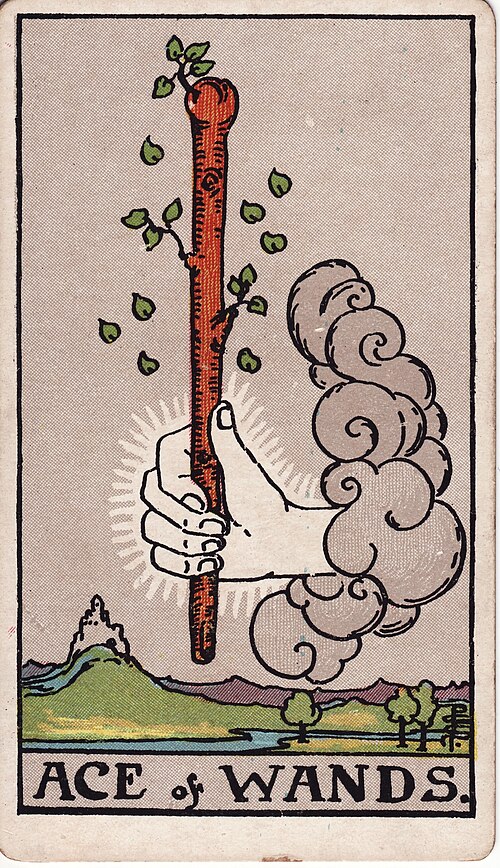
A hand emerges from a pale cloud at the right side of the card and grips a living wand. Small green leaves and shoots appear along the branch, while several leaves drift away. The wand projects diagonally into open space. In the distance are a castle or fortified building, a winding river, low ground, and blue-gray mountains beneath a light sky. The foreground is warm and earthy, set against the cooler background. No human face is visible, so the image presents the offer of an impulse rather than a named character with a fixed personality.
The visible contrast matters: a single hand and branch occupy the foreground, while the landscape opens toward distance. The image can therefore support a reading about potential meeting circumstances, a first move, or a resource that still needs care. Traditional RWS commentary associates the Ace with creation, enterprise, and a beginning; this article treats those as historical and interpretive vocabulary, then checks them against the question and position. The leaves show vitality, but they do not guarantee easy growth.
Keywords and how they arise
A concise keyword set is spark, initiative, creativity, desire, courage, opportunity, and growth. Spark follows from the sudden hand-held branch; initiative follows from the hand presenting one active object; creativity and desire follow from the living shoots and the suit tradition; courage follows from the branch extending into an open landscape; opportunity follows from the card showing a resource before it has become a project; and growth follows from the leaves, with the important reminder that growth requires follow-through.
- Keywords: spark
- initiative
- creativity
- desire
- courage
- opportunity
- growth. Read them as possible functions of the image and suit, not as a fixed answer list.
Upright meaning
Upright, the Ace of Wands can describe a clear beginning: an idea that has enough heat to deserve a first experiment, a desire that identifies a direction, or a chance to act with more vitality. Its strength is immediacy. You do not need the whole route before taking a safe first step. The card favors naming the aim, gathering a modest amount of support, and moving from imagination into a visible test.
Its risk is excess. Excitement can become haste, overpromising, impatience with detail, or a burst of effort that cannot be sustained. The wand is alive, but the card does not show a completed harvest. A practical upright action is to define one next step, its time limit, and an observable sign that the experiment is working. Protect the spark with rest, boundaries, and honest feedback rather than turning enthusiasm into pressure.
Reversed meaning
Reversed, the Ace of Wands does not automatically mean failure or bad news. It may show blockage: the idea is present but cannot yet reach action. It may show internalization: desire or creativity is being processed privately before it is ready to share. It can also indicate excess, such as scattered impulses, compulsive starting, irritability, or a demand to act before conditions are sound. In a timing question, it may point to delay while energy, permission, or practical support is restored.
The direction adjustment is to ask what the spark needs rather than forcing a performance. Reduce the scope, check whether the goal is actually yours, make room for recovery, or move the energy into research and rehearsal. If the card appears reversed beside strong action cards, it may mean that the opportunity exists but the delivery is poorly timed. If it appears beside quiet or receptive cards, internal preparation may be the wiser interpretation.
Applications in everyday life
Relationships and emotions: The card can suggest attraction, renewed enthusiasm, an honest invitation, or the courage to begin a different pattern. It does not read a third party’s mind or prove commitment. For an established relationship, ask what shared activity could restore aliveness. Watch for chemistry being mistaken for compatibility, or for one person’s urgency becoming pressure on the other.
Work and study: The Ace favors a proposal, a new subject, a portfolio experiment, or the first outline of a project. Strength comes from initiative and willingness to learn by doing. The risk is skipping research, permissions, or boring but necessary steps. Turn the idea into a small deliverable, identify a reviewer, and set a realistic checkpoint.
Money and resources: Read this as a possible opening for productive use of resources, not as a promise of profit or investment return. Check costs, downside, cash flow, and whether the proposed action is affordable if it takes longer than expected. A reversed Ace may advise pausing a purchase, rebuilding a budget, or separating impulse from a tested plan.
Personal growth: The card invites a body-level check on what feels alive and what merely feels urgent. Choose a practice that can be repeated, such as writing for fifteen minutes, applying for one opportunity, or having a direct conversation. Let the journal record evidence and changing feelings instead of treating the card as a verdict.
Ace of Wands in spreads and positions
One-card prompt: “What beginning deserves a safe experiment today?” Upright, emphasize the available spark and the smallest useful action. Reversed, examine the blockage, hidden desire, excess, or delay before deciding whether action is appropriate.
Three-card past, present, future: In the past, the Ace can describe the origin of an idea or an earlier surge of motivation. In the present, it highlights what is ready to be initiated now. In the future, it suggests a possible opening, but the surrounding cards and practical choices determine whether the opening is developed. In a situation, action, outcome spread, it names the live potential; the middle card shows how to handle it; the last shows the likely consequence of that handling, not a guaranteed fate.
Relationship positions: As self, the Ace describes your willingness to initiate, desire, or creative contribution. As the other person, it describes the energy they bring to the interaction, not their private thoughts or a fixed intention. As interaction, it highlights the shared spark, the invitation, or the need to negotiate pace and consent. Reversed in any position, ask whether energy is withheld, misdirected, excessive, or simply not ready.
Decision positions: In opportunity, the Ace points to a promising first move or a chance to learn through action. In risk, it warns of haste, inflated enthusiasm, or an attractive idea without support. In advice, it recommends a bounded experiment and clear criteria rather than a dramatic leap. In obstacle, it can show fear of beginning, too many beginnings, or a need to protect energy. In outcome, it often describes the result as renewed momentum or a new phase, while the question and other cards set the scale.
Instructional combination example
Instructional, not a real case: The World followed by the Ace of Wands can be read as completion creating room for a new beginning. The World supplies closure and perspective; the Ace supplies the next living impulse. If the Ace is reversed, the combination may instead ask for a deliberate pause after completion, so the next project is chosen rather than used to escape stillness. Adjacent cards modify one another; neither card is a standalone prediction.
Common misreadings, traditions, and responsible use
Do not reduce the Ace of Wands to guaranteed sex, pregnancy, fame, travel, or immediate success. A sprouting branch is visible; the larger claims are interpretive possibilities that need context. Do not confuse a promising beginning with a completed plan, and do not treat reversed as automatically negative. Marseille-style decks often show a pip of wands rather than an RWS scene, so number, suit, and surrounding cards may carry more of the analysis. Schools also differ on elemental and astrological correspondences. RWS and Marseille traditions differ in the numbering of Strength and Justice and in some imagery; this series uses RWS order and primary image analysis.
Tarot can support cultural study, symbolic reading, and self-reflection, but it is not scientifically validated predictive power. Do not use this card as medical, legal, or financial advice, and do not use it to make guaranteed-fate claims or to investigate another person without consent. For high-stakes choices, combine reflection with qualified professional guidance and verifiable information.
Tarot journal prompts
- 1. What idea or desire is genuinely alive, and what evidence would justify a small test?
- 2. Where am I rushing, withholding, or spreading my energy too thin?
- 3. What support, boundary, or recovery time would help this beginning become sustainable?
Suggested learning links
Continue backward to The World (tarot-card-the-world) and forward to the Two of Wands (tarot-card-two-of-wands). For method, build on Tarot for Beginners (tarot-for-beginners), the Wands suit guide (tarot-wands), the Upright and Reversed guide (tarot-upright-and-reversed), and the Spread glossary (glossary-spread). These links provide foundations without replacing the Ace-specific image and position analysis above.